TL;DR (Key Takeaways):
- AI SDRs automate prospecting, outreach, and meeting scheduling 24/7 at 70-83% lower cost than human SDRs
- Where AI wins: Scale (1,000+ contacts daily), speed (sub-5-minute responses), consistency, and cost efficiency
- Where humans win: Emotional intelligence, relationship building, complex objections (25% vs 15% meeting-to-opportunity conversion)
- Major risks: GDPR/CCPA violations (€20M penalties), domain blacklisting, TAM burnout from generic outreach
- Best use: High-volume top-funnel tasks with transactional products; avoid for complex enterprise sales or high-ACV deals
- Hybrid approach: AI handles repeatable execution; humans focus on relationship-driven conversations that close deals
The average SDR spends over two-thirds of their time on tasks that have nothing to do with selling. Meanwhile, 73% of inbound leads never receive a first reply, and response times hover around 48 hours.
AI SDRs promise to fix this. They automate prospecting, qualify leads, and book meetings while your team sleeps. But they also carry compliance risks, burn through your total addressable market with generic outreach, and convert meetings to opportunities at rates 40% lower than human reps.
This guide clarifies what AI SDRs actually do, where they excel, and when they'll do more harm than good to your pipeline.
What Is an AI SDR? (Core Definition & Capabilities)
By Definition
An AI SDR is software that uses natural language processing and machine learning to autonomously handle top-of-funnel sales activities. It prospects, sends outreach, qualifies leads, and schedules meetings without human intervention.
Unlike basic email automation, AI SDRs make decisions. They analyze prospect responses, adjust messaging based on engagement signals, and route qualified leads to your team.
Core Functions AI SDRs Handle
Automated outreach: AI SDRs send personalized emails and follow-ups based on CRM data, operating 24/7 without fatigue. They can engage over 1,000 contacts daily while maintaining message consistency.
Lead qualification: The software analyzes prospect responses and engagement patterns to determine sales readiness. It scores leads based on reply sentiment, questions asked, and interaction frequency.
Appointment scheduling: When prospects express interest, AI SDRs book meetings directly into rep calendars by accessing availability and sending calendar invites. This eliminates the back-and-forth scheduling dance.
Data enrichment: Every interaction gets logged automatically. AI SDRs track conversations and add context to prospect records, building a richer picture of each lead's journey.
24/7 engagement: With over 75% of inbound inquiries happening outside 9-to-5 hours, AI SDRs ensure someone always responds. They maintain first-response advantage when human teams are offline.
Technology Stack: How AI SDRs Work
AI SDRs combine three core technologies:
- Machine learning algorithms analyze historical data to recognize patterns in successful conversations, predict lead behavior, and improve targeting over time.
- Natural language processing enables AI SDRs to understand text meaning in emails and replies. NLP helps them interpret lead intent and generate responses that sound human rather than robotic.
- Data analytics powers targeting decisions. The software processes firmographic data, engagement signals, and behavioral patterns to identify which prospects to contact and when.
What AI SDRs Are Not
AI SDRs lack emotional intelligence. They cannot read tone, pick up on subtle cues, or build genuine rapport the way humans naturally do in conversations.
They struggle with relationship-building depth. While AI can maintain consistency, it cannot apply personal traits or emotional intelligence to create the strong connections that close complex deals.
Complex objections expose AI limitations. When prospects raise nuanced concerns about implementation, ROI uncertainty, or organizational change, AI SDRs fail to provide the consultative dialogue required.
AI Reply Agents Explained
What Is an AI Reply Agent?
An AI reply agent is a focused automation that triages and responds to inbound email replies within seconds. Unlike full AI SDRs that handle the entire prospecting cycle, reply agents specifically manage the flood of responses after outreach campaigns launch.
Manual reply triage consumes 2 to 4 hours per SDR daily. Reply agents eliminate this bottleneck by reading incoming emails, understanding intent, and routing qualified leads while handling objections and out-of-office messages automatically.
Key Differences: AI SDR vs AI Reply Agent
AI SDRs operate across the full prospecting workflow. They find leads, initiate outreach, qualify prospects, and book meetings autonomously across multiple channels including email, LinkedIn, and phone.
AI reply agents focus exclusively on inbound response handling. They classify intent, draft context-aware responses, and route qualified conversations to human SDRs. Think of them as specialized assistants rather than full replacements.
Core Capabilities
Intent classification: Reply agents tag responses as interested, not interested, out of office, or requesting more information. This routing logic ensures the right workflow triggers for each reply type.
Context-aware responses: Unlike basic autoresponders that send generic messages, AI reply agents understand conversation context. They reference previous emails, handle objections, and book meetings without constant human oversight.
Conversation threading: The software reads full email threads to maintain context. It tracks what was promised, which questions were asked, and where the conversation stands before drafting replies.
Automatic lead routing: Qualified leads get pushed directly to SDR queues or AE calendars. Reply agents identify buying signals and escalate hot prospects while filtering out noise.
AI SDR vs Human SDR: Capability Comparison
Where AI SDRs Excel
Scale: AI SDRs engage thousands of prospects simultaneously without quality degradation. Human SDRs typically max out around 40 calls daily, while AI handles 1,000+ contacts.
Speed: AI operates continuously. It closes the 16-hour gap when human teams are offline, maintaining engagement across time zones and ensuring sub-5-minute response times.
Consistency: AI SDRs deliver steady results unaffected by writer's block, fatigue, or mood. Every prospect receives the same quality of outreach regardless of when they enter your pipeline.
Cost efficiency: AI costs $500 to $5,000 monthly, which is 70-83% less than human SDRs when factoring in salary, benefits, training, and management overhead. You skip hiring costs and turnover entirely.
Response time advantage: Sales teams using sub-5-minute reply automation report 3x higher meeting booking rates compared to 30-minute manual responses. Speed directly impacts conversion.
Where Human SDRs Excel
Emotional intelligence: No AI matches human-level emotional intelligence, which remains crucial in modern sales. Humans read tone, adjust approach mid-conversation, and build authentic trust.
Relationship building: Humans apply personal traits and emotional intelligence to create stronger connections. They remember details, reference past conversations naturally, and make prospects feel valued rather than processed.
Cultural nuance interpretation: Human SDRs spot and interpret cultural context that AI misses. They understand regional communication styles, industry-specific language, and organizational politics.
Complex objection handling: When prospects raise sophisticated concerns, humans think creatively and offer tailored solutions. They pivot strategies, tell relevant stories, and address unspoken worries.
Performance Benchmarks
The conversion gap reveals AI's relationship deficit. AI SDRs convert meetings to qualified opportunities at 15% compared to human SDRs' 25%. This 40% performance gap matters significantly in complex sales scenarios.
Response rates tell a different story. AI-powered outreach generates up to 50% higher email response rates than traditional methods when properly configured. Volume and speed advantages drive more top-funnel engagement.
Cost Analysis: AI vs Human SDR
AI SDRs run on subscription models ranging from $12,000 to $60,000 annually. This includes software licensing, support, and integration costs.
Human SDRs cost approximately $6,000 monthly, totaling $72,000 annually before accounting for benefits, training programs, management time, and turnover replacement costs. Full-loaded costs often exceed $90,000.
AI SDR Limitations & Risk Factors
Technical Limitations
Data dependency: AI SDRs rely heavily on data quality to function effectively. Poor CRM hygiene leads to inaccurate targeting, irrelevant messaging, and wasted outreach that damages your brand.
Limited adaptability: AI struggles with unscripted situations that fall outside its training parameters. When prospects respond in unexpected ways, AI defaults to generic responses or fails to engage appropriately.
Emotional cue blindness: AI excels at processing data but cannot read emotional nuance. It misses frustration in tone, enthusiasm in word choice, and urgency in timing.
Performance Gaps That Matter
The 40% conversion gap between AI's 15% and human's 25% meeting-to-opportunity rates reveals relationship-building deficits. In complex sales scenarios where deal size justifies human touch, this gap directly impacts revenue.
AI SDRs are not yet capable of replacing human SDRs despite marketing claims. The technology handles volume well but lacks the strategic thinking and genuine empathy required for sophisticated sales motions.
When to Use AI SDRs: Decision Framework
Best Use Cases for AI SDRs
AI SDRs work best for high-volume, repetitive tasks at the top of the funnel where scale and consistency matter more than nuance. Think initial contact, basic qualification, and appointment setting.
Small to mid-sized B2B companies doing outbound sales but lacking large SDR teams benefit most. AI provides enterprise-level coverage without enterprise headcount.
Inbound lead volume surges expose human capacity limits. When your SDRs can't qualify all inbound leads, AI engages prospects 24/7 without delay, preventing lead decay.
For businesses with large TAMs, limited budgets, and relatively transactional products, AI SDRs enable pipeline generation impossible through human-only approaches. The math simply works when you need to contact thousands of prospects monthly.
When NOT to Use AI SDRs
Complex enterprise sales requiring deep relationship building are poor fits for AI. When deals involve navigating organizational politics, building consensus across departments, and maintaining relationships over months, humans excel.
High-ACV sales motions justify human investment. If the average deal size exceeds $50,000, the 40% conversion gap between AI and human SDRs costs real revenue. Human SDRs ask better follow-up questions, disqualify earlier, and protect AE time.
Situations requiring consultative dialogue expose AI weaknesses. When prospects raise concerns about implementation complexity, organizational change management, or ROI uncertainty, they need strategic thinking that AI cannot provide.
Hybrid Model Recommendations
The strongest teams use hybrid models where AI handles repeatable execution and humans focus on conversations that move deals forward. AI qualifies and books; humans build relationships and close.
AI SDRs scale operations and remove the need to hire more SDRs, but you still need humans to move qualified leads down the funnel. The technology augments rather than replaces.
67% of B2B sales leaders expect AI to significantly change their go-to-market strategy within two years. The question isn't whether to adopt AI, but how to integrate it strategically.
Buzz AI Employees: The All-in-One Alternative
What Makes Buzz Different
Most sales teams juggle separate tools for prospecting, data enrichment, email automation, LinkedIn outreach, and CRM management. This software exhaustion drains productivity and creates data silos.
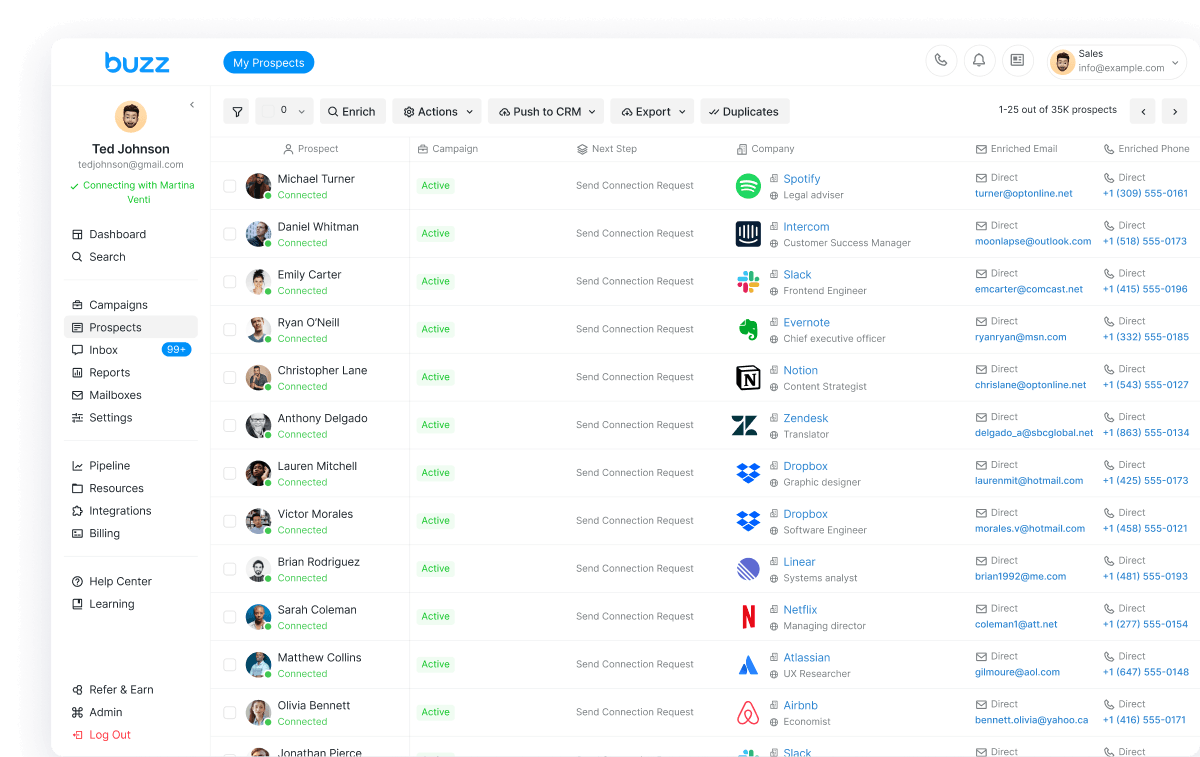
Buzz unifies Identify, Enrich, and Engage in a single platform. AI Employees learn from your data, craft personalized messages dynamically, and book meetings autonomously across email, social, and phone. You get the scale advantages of AI SDRs without managing multiple point solutions.
How Buzz AI Employees Work
AI Employees automatically identify prospects matching your ICP, enrich records with verified contact data, and deploy multi-channel sequences that adapt based on engagement signals. Unlike standalone AI SDRs that only handle email, Buzz orchestrates coordinated outreach across channels.
The system integrates prospecting, enrichment, and outreach in one workflow. You define your ideal customer profile, and AI Employees find matching prospects, verify their contact information, and launch personalized campaigns without manual data exports or imports.
Key Capabilities
Multi-channel engagement: Email, the Social Platform, and phone outreach orchestrated by AI ensures you reach prospects where they're most responsive. The platform manages cadence across channels to avoid overwhelming contacts.
Dynamic personalization: Messages adapt based on prospect behavior and engagement patterns rather than following rigid templates. AI Employees reference company news, job changes, and interaction history to maintain relevance.
Autonomous meeting booking: AI Employees qualify leads through conversation, identify buying signals, and schedule directly into rep calendars. This eliminates scheduling friction that kills momentum.
Native CRM sync: Bi-directional integration with Salesforce, HubSpot, and Pipedrive ensures activity logs, contact updates, and opportunity creation flow automatically. No manual data entry required.
Built-in deliverability: Email warm-up, verification, and reputation management come included. Buzz handles the technical complexity of maintaining inbox placement rates above 95%.
Ready to Scale Without Software Exhaustion?
Buzz streamlines your sales process by eliminating the need to juggle separate tools for prospecting, enrichment, and engagement. Our AI Employees revolutionize your sales workflow, delivering predictable and data-driven outcomes.
Schedule a demo to explore how Buzz's delivers the benefits of AI SDRs without the limitations.
The Winning Formula: AI for Scale, Humans for Revenue
AI SDRs excel at volume, speed, and consistency for top-of-funnel tasks. They cost 70-83% less than human SDRs and operate 24/7 without fatigue. But they convert meetings to opportunities at rates 40% lower than humans.
The technology works best in hybrid models where AI handles repeatable execution and humans focus on relationship-driven conversations. Use AI for high-volume prospecting, basic qualification, and appointment scheduling. Reserve human SDRs for complex enterprise sales, high-ACV deals, and situations requiring emotional intelligence.
The future of sales development isn't AI versus humans. It's strategic deployment of both, with clear understanding of where each excels.