TL;DR (Key Takeaways):
The Core Difference:
- CRM systems are systems of record that manage existing customer relationships, track pipeline stages, and organize internal data
- Sales intelligence platforms are systems of action that find new prospects, enrich data with external sources, and automate multi-channel outreach
- Most successful B2B teams use both together, with sales intelligence feeding qualified prospects into CRM for relationship management
When to Use Each:
- Use CRM when you need to manage existing customer lifecycles, track complex deal stages, and coordinate across sales/marketing/service teams
- Use sales intelligence when you need to identify new prospects, enrich contact data, and execute high-volume outbound campaigns
- Early-stage teams can start with all-in-one platforms like Buzz that combine both capabilities
Critical Stats:
- CRM alone leaves 67% of deals stalling from insufficient prospect context
- Sales intelligence tools identify 3-5x more qualified prospects than manual research
- Teams using both integrated see 26% more meetings booked and 42 hours saved monthly per rep
- Data decays 30% annually in CRMs without external enrichment
The Modern Solution
- All-in-one sales engagement platforms like Buzz bridge the gap by combining 250M+ contact databases, multi-channel automation, and built-in pipeline management
- Buzz can serve as either a CRM alternative or integrate with existing Salesforce/HubSpot/Pipedrive investments
- Integration strategy maintains CRM as system of record while adding powerful prospecting capabilities CRMs lack natively
The Bottom Line
CRM manages what you have; sales intelligence finds what's next. The question isn't which to choose, but how to integrate both for maximum pipeline velocity.
Your sales team just closed another deal. Your CRM dutifully logs the win, updates the forecast, and sends a notification to the VP of Sales. But here's the problem: while your CRM excels at tracking what you already have, it offers zero help finding what comes next.
72% of B2B sales leaders report struggling with tool fragmentation across their tech stack. The core issue? CRMs manage existing relationships brilliantly, but leave teams prospecting blind. Sales intelligence platforms solve the opposite problem: they find new opportunities and enrich data with external sources, but they're not built to manage complex customer lifecycles.
Modern sales teams need both paradigms working together. This analysis examines when to use each tool type, how they complement one another, and which all-in-one platforms bridge the gap. I've tested platforms hands-on, reviewed vendor documentation, and analyzed verified user data to cut through the marketing noise.
Why CRM and Sales Intelligence Both Matter
CRM systems manage over $4.5 trillion in pipeline annually across B2B organizations. They're the backbone of relationship management, deal tracking, and revenue forecasting. But without sales intelligence feeding them qualified prospects, CRMs become data graveyards filled with stale contacts and dead-end opportunities.
Sales intelligence tools identify 3-5x more qualified prospects than manual research methods. Teams using both CRM and sales intelligence together see 26% more meetings booked and save an average of 42 hours monthly per rep. The math is simple: CRMs track and analyze what you have, while sales intelligence finds what's next.
Here's the challenge: 67% of deals stall from insufficient prospect context. Real-time data enrichment improves conversion rates by 40% because reps enter conversations armed with funding data, tech stack information, and verified contact details. Multi-channel engagement requires external data sources that CRMs simply don't provide natively.
CRM Systems vs Sales Intelligence Platforms: Quick Reference
CRM systems manage existing customer relationships and track pipeline stages. They're your system of record for every interaction, deal stage transition, and customer touchpoint. Think Salesforce, HubSpot, or Pipedrive organizing your entire revenue operation.
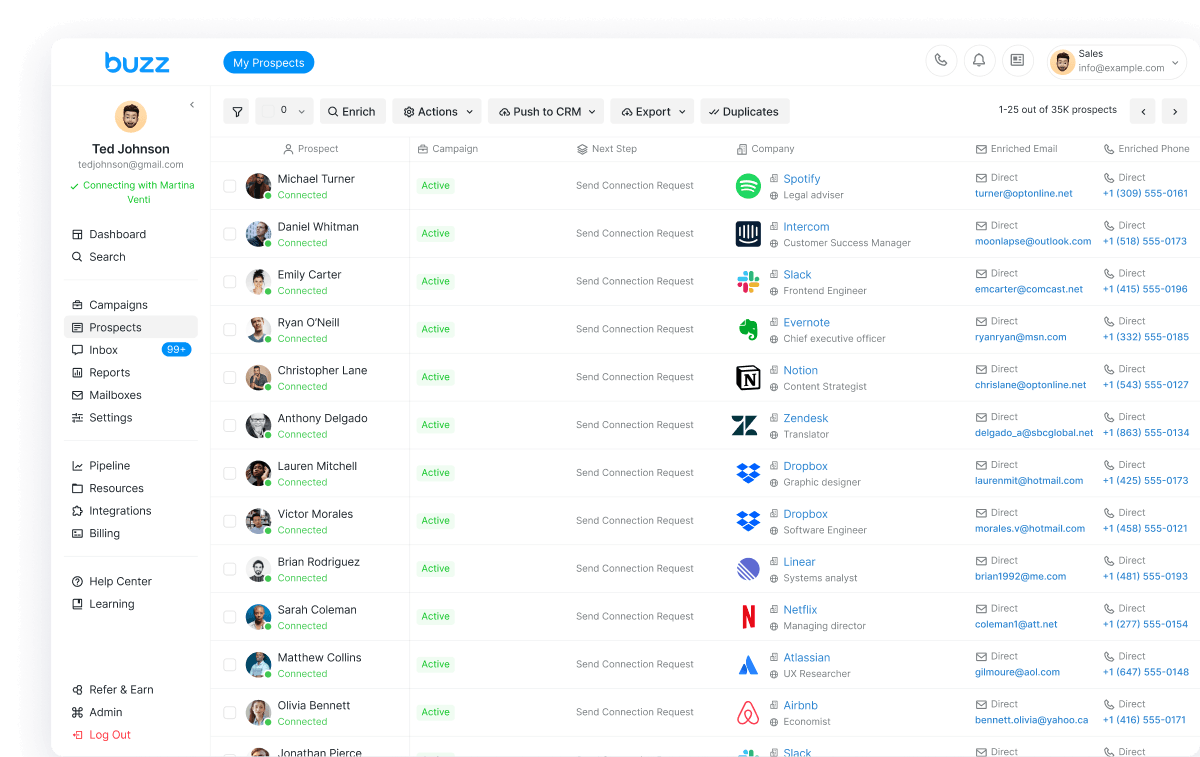
Sales intelligence platforms enrich data, identify prospects, and automate outreach across multiple channels. They're systems of action that find new opportunities and execute campaigns. Modern platforms like Buzz bridge both paradigms in a unified interface, combining contact databases with engagement automation and built-in pipeline management.
| Feature | CRM Systems | Sales Intelligence Platforms |
| Core Focus | Relationship management, pipeline tracking | Prospecting, data enrichment, engagement automation |
| Key Features | Contact management, deal stages, reporting | Contact databases, email verification, multi-channel outreach |
| Primary Use Case | Primary Use Case Track existing customer interactions | Identify and qualify new opportunities |
| Data Source | Internal (user-entered or imported) | External (real-time enrichment from market data) |
| Typical Users | Sales reps, account managers, CSMs | SDRs, BDRs, outbound teams |
Feature-by-Feature Analysis
Data Source and Contact Coverage
CRM systems store and organize internally-entered or imported contact data. They have no native external data sourcing or enrichment capabilities. Your sales reps manually update contact information, and that data decays at roughly 30% annually without enrichment tools.
Sales intelligence platforms provide access to contacts and companies. Real-time data enrichment delivers verified work email, personal email, direct phone numbers, company funding, and firmographic data. Multi-stage email verification ensures deliverability before you send a single message.
Multi-Channel Engagement and Outreach Automation
CRM systems track communication history across channels like email, phone, and meetings. Some platforms offer basic email templates and sequence capabilities. But they lack native LinkedIn, or video outreach automation.
Buzz delivers multi-channel outreach across email, social, and video messaging in one platform. AI-powered personalization generates 1-to-1 icebreakers and magic campaigns that adapt to each prospect. Sentiment analysis gauges lead interest in real-time, and AI-powered reply generation suggests context-aware follow-ups.
Consider this scenario: An SDR needs to engage 500 prospects across email and social. With a CRM approach, they manually export the list, upload to separate engagement tools, and spend 20+ hours weekly on coordination.
With Buzz, they build the campaign directly from the enriched prospect database and set up automated follow-ups based on prospect sentiment. Setup takes 2-3 hours, then execution runs automatically.
Pipeline Management and Deal Tracking
CRM systems shine here. Customizable deal stages and pipeline views represent their core competency. Advanced workflow automation moves deals through stages, revenue forecasting uses weighted pipeline probabilities, and comprehensive reporting dashboards track pipeline health.
Buzz offers built-in pipeline management with customizable deal stages as a lightweight CRM alternative for teams without enterprise systems. Integration with Salesforce, HubSpot, and Pipedrive provides two-way sync for teams that need both. Seamless data flow prevents duplicate entry between systems.
Integration and Deliverability
CRM systems offer extensive marketplaces with 1,000+ third-party integrations. They're the central data hub for your entire revenue tech stack. But they offer basic email sending through connected mailboxes with no reputation management or warming capabilities.
Buzz integrates with Gmail, Outlook, Zapier, and major CRM platforms. Automated email warming systems build and maintain sender reputation. The platform repairs email account reputation to avoid sending limits and uses multi-stage email verification to prevent bounces before sending.
Pricing and Total Cost of Ownership
| Tier | Sales Intelligence (Buzz) | Typical CRM Systems |
| Entry/Starter | $225/month (3 seats included; 50 credits per seat; $75 per additional seat) | $0-$45/user/month (basic features) |
| Mid-Tier | $450/month (3 seats included; 100 credits per seat; $150 per additional seat) | $75-$150/user/month (advanced automation) |
| Enterprise | Custom | $300+/user/month (custom, enterprise features) |
Here's what people miss: CRM pricing looks cheaper upfront, but you'll pay an additional $50-$200 per user monthly for third-party data enrichment integrations. Buzz includes data costs in the subscription tier, making total cost of ownership more predictable.
CRM systems require 2-6 months for enterprise implementations with data migration and workflow configuration. Buzz onboards in 1-2 weeks with intuitive setup.
ROI Metrics That Actually Matter
Buzz Pro clients save 42 hours monthly on average and book 26% more client meetings.
The ROI Formula = (Meetings gained × close rate × deal value) - platform cost
For example, 10 additional meetings × 20% close rate × $50K deal value = $100K ARR. Payback period typically hits within 1-2 months for outbound teams.
CRM ROI comes from improved forecasting accuracy (10-15% typical) and 20-30% reduction in administrative tasks. Payback period runs 6-18 months depending on implementation complexity.
Sales intelligence platforms like Buzz offer a significantly faster and more direct return on investment (ROI) for outbound sales teams, often achieving payback within 1-2 months through tangible gains in meetings, deals, and annual recurring revenue (ARR). In contrast, CRM ROI is typically realized over a longer 6-18 month period, stemming from less direct benefits such as enhanced administrative efficiency and improved forecasting accuracy.
Who Each Platform Serves Best
CRM systems work best for companies with 20+ employees managing existing customer relationships. You need complex workflow automation, custom processes, dedicated sales operations resources, and customer lifecycle management beyond the initial sale.
Buzz serves early-stage companies (5-50 employees) focused on outbound prospecting. Teams without existing CRM or seeking a lightweight all-in-one solution benefit most. Organizations prioritizing new business development, sales teams needing immediate time-to-value, and agencies requiring multi-channel prospecting at scale all fit the profile.
Buzz excels in B2B SaaS companies running high-volume outbound to technology buyers. Agencies managing prospecting for multiple clients leverage the data-driven personalization. Startups need the all-in-one solution without CRM complexity or cost.
CRM systems win in enterprise organizations with complex sales processes involving multiple stakeholders and long cycles. Account-based selling requires managing strategic accounts with deep relationship mapping. Industries with compliance requirements like financial services and healthcare require audit trails.
The Modern Convergence: All-in-One Sales Engagement Platforms
Buzz combines sales intelligence with engagement and CRM capabilities in a unified interface. The platform eliminates software exhaustion from managing multiple disconnected tools with its "Identify, Enrich, Engage. All Channels" approach.
For teams without CRM, Buzz's built-in pipeline management serves as a lightweight alternative. For teams with existing CRM, it integrates with Salesforce, HubSpot, and Pipedrive via two-way sync. The flexible architecture adapts to your business stage and growth trajectory.
Key Buzz Capabilities Spanning Both Categories
On the sales intelligence side, Buzz provides access to 250M+ contacts and 11M+ companies. Real-time data enrichment delivers verified emails and phone numbers. Integration with Crunchbase, ZoomInfo, and other data sources adds company funding and firmographic data.
For engagement automation, Buzz offers multi-channel outreach across email, social, and video messaging. AI Magic Campaigns generate personalized icebreakers. Automated A/B testing improves campaign performance continuously. Automated email warming and deliverability optimization protect sender reputation.
The CRM and pipeline features include customizable internal pipeline with deal stage management. Two-way synchronization with major CRM platforms maintains data consistency whereas, integration with Gmail, Outlook, and Zapier ensures workflow continuity.
Final Verdict and Next Steps
| Feature | CRM Systems | Sales Intelligence (Buzz) |
| Primary Purpose | ✅ Manage existing relationships and pipeline | ✅ Find and engage new prospects |
| Data Sourcing | ❌ Internal only (user-entered) | ✅ 250M+ contacts, 11M+ companies external database |
| Multi-channel Outreach | ❌ Requires third-party tools | ✅ Email, the Social Platform, video in a unified platform |
| AI Personalization | ⚠️ Limited (some platforms) | ✅ AI Magic Campaigns, sentiment analysis, reply generation |
| Implementation Time | ❌ 2-6 months (enterprise) | ✅ 1-2 weeks with quick onboarding |
| Email Deliverability | ❌ No warming or verification | ✅ Automated warming and multi-stage verification |
| Built-In Pipeline | ✅ Core competency with advanced features | ✅ Lightweight CRM alternative for small teams |
| CRM Integration | ✅ Central hub for revenue stack | ✅ Two-way sync with Salesforce, HubSpot, Pipedrive |
| Pricing | ✅ Free-$300+/user (varies by features) | ⚠️ $75-$150/user (includes intelligence + engagement) |
| Best For | ✅ Relationship management, complex workflows | ✅ Outbound prospecting, data-driven engagement |
When to Use Buzz as CRM Alternative vs CRM Complement
Buzz works as an all-in-one solution for early-stage companies without existing CRM investment. Teams of 5-20 focused primarily on outbound prospecting avoid CRM implementation complexity. The value proposition: built-in pipeline eliminates separate CRM purchase, full sales intelligence and engagement capabilities come included, and faster onboarding (1-2 weeks versus 2-6 months).
Buzz complements existing CRM for established teams with Salesforce, HubSpot, or Pipedrive investment. Organizations needing enterprise CRM features like custom objects and advanced reporting keep their CRM. The complementary value: adds powerful sales intelligence to existing CRM investment, enriches CRM records with external data automatically, and makes it 72% easier to get in front of ideal clients.
What to Consider with Buzz
The Starter plan at $225/month runs higher than free CRM options. Pre-revenue startups with fewer than 5 employees may find it expensive. Total cost still beats CRM plus sales intelligence stack combined.
The extensive feature set requires time to fully master. Breadth of functionality can feel complex initially. Advanced AI features need experimentation for optimization.
Buzz covers data enrichment, AI, dialer, and voicemail drops. High-volume teams need to monitor credit usage.
The built-in pipeline lacks advanced enterprise CRM features. Complex workflow automation requires CRM integration. Advanced reporting and forecasting remain more limited than Salesforce or HubSpot.
When Buzz Is the Clear Choice
Buzz makes sense when outbound prospecting drives your growth strategy. Companies get an all-in-one solution without CRM complexity. Outbound-focused SDR and BDR teams need sales intelligence and multi-channel engagement in one place.
Teams with existing CRMs add powerful prospecting without replacing current investment. Agencies managing multiple clients leverage the 250M+ contact database with AI personalization that scales. Organizations seeking rapid ROI benefit from 42 hours saved monthly and 26% more meetings booked.
CRMs remain essential for relationship management and customer lifecycle tracking. Buzz complements CRM by solving prospecting challenges CRMs don't address. Integration strategy maintains CRM as system of record. For the smallest teams, Buzz's built-in pipeline delays CRM investment needs.