Picture sending a parcel to an address that doesn't exist. The package bounces back, the courier marks you as unreliable, and your next legitimate delivery gets flagged for extra scrutiny. Now multiply that scenario by thousands of emails, and you've got the hidden cost of unverified contact lists: wasted budget, damaged reputation, and campaigns that never reach their targets.
Email verification protects your sender reputation and ensures your outreach actually reaches prospects. For marketers launching campaigns, founders building sales pipelines, and SDRs filling quotas, verification has shifted from optional hygiene to business-critical infrastructure. With 30% of B2B contact data becoming invalid annually, the question isn't whether to verify—it's how to build verification into your workflow before bad data torpedoes your deliverability.
What is Email Verification (And Why Does It Matter)?
Email Validation vs. Email Verification
Email validation checks syntax and format—confirming an address follows the [email protected] structure without typos or formatting errors. Email verification goes several steps further, confirming deliverability through MX record lookups, SMTP handshakes, and mail server validation to verify the mailbox actually exists and can receive messages.
Think of validation as checking if a street address is formatted correctly, while verification confirms someone actually lives there and accepts mail. Understanding this distinction is fundamental to implementing effective B2B sales email verification techniques.
The Business Case for Email Verification
Poor data quality costs U.S. businesses $3.1 trillion annually, with individual organizations losing $12.9-$15 million per year. For sales teams specifically, SDRs waste 27% of their time—546 hours annually—on invalid contacts, translating to $1,200+ monthly cost per rep.
B2B email addresses degrade at roughly 2% per month, meaning 22.5% of your database becomes invalid every year. A list you purchased or scraped three months ago has already lost significant reachability before your first campaign launches.
How Bad Data Damages Sender Reputation
Email providers track your bounce rate like a credit score. ISPs consider bounce rates below 2% healthy, 2-5% problematic, and above 5% critical. Government email services like Cloud.gov warn users at 2% and disable sending entirely at 4%.
When you send to invalid addresses, mail servers note the failure and adjust how they treat future emails from your domain. Too many failed deliveries, and providers stop letting your messages through at all. This is why B2B sales email verification techniques focus heavily on preventing bounces before they occur.
The Consequences of Skipping Email Verification
Hard Bounces and Soft Bounces
Hard bounces occur when an email address doesn't exist, the domain is invalid, or the recipient server permanently rejects delivery. These immediately damage your sender reputation because they signal you're sending to addresses you haven't properly vetted.
Soft bounces indicate temporary delivery issues—full inboxes, server downtime, or messages too large for the recipient's mailbox. While less damaging than hard bounces, repeated soft bounces to the same address eventually convert to hard bounces in most email platforms.
Spam Traps and Blacklists
Spam traps come in three varieties: pristine traps (email addresses that were never valid, hidden in websites to catch scrapers), recycled traps (formerly valid addresses abandoned for 6-12 months then repurposed by ISPs), and typo traps (common misspellings like gmial.com).
Hitting spam traps signals poor list hygiene and can lower deliverability by up to 50%. Repeated violations get your IP or domain added to major blacklists like Spamhaus or Barracuda, which prevent inbox delivery across thousands of organizations. Proper B2B sales email verification techniques include spam trap detection to avoid these reputation killers.
Deliverability Degradation
Gmail and Yahoo rolled out strict requirements in 2024 that fundamentally changed the deliverability landscape. Both providers now enforce a 0.3% maximum spam complaint rate, with Gmail recommending staying below 0.10% to avoid filtering.
One in four emails sent to Yahoo, AOL, Hotmail, and Outlook users failed to reach inboxes in January 2024, while one in ten emails never made it to Gmail inboxes.
How Email Verification Works: Core Technical Methods
Modern B2B sales email verification techniques combine multiple validation layers to ensure maximum accuracy and deliverability protection.
Syntax and Format Validation
Syntax validation confirms proper email structure—checking for required elements like the @ symbol, a username before it, and a domain after it. This first-pass check catches obvious typos before they become bounces.
Domain and MX Record Checks
MX records are DNS records that specify which mail servers are responsible for receiving emails on behalf of a domain. Verification tools query these records to confirm the domain exists and has configured mail servers capable of receiving messages. This is a foundational component of b2b sales email verification techniques.
SMTP Verification (Mailbox-Level Validation)
SMTP verification simulates an email handshake with the recipient's mail server to confirm the specific mailbox exists—without actually sending a message. This method delivers 99.9% accuracy for active mailboxes with average verification times of 2-3 seconds.
Catch-All Domain Detection
Catch-all domains accept all email addresses sent to them, even if the specific mailbox doesn't exist. Catch-all addresses can lead to 9% average bounce rates if you send to invalid variations. However, valid catch-all emails show 67% higher engagement rates because they're targeted less frequently. Advanced b2b sales email verification techniques include specialized catch-all detection to identify which domains require extra validation.
Disposable and Role-Based Email Filtering
Disposable email services like 10 Minute Mail and TempMail provide temporary addresses that self-destruct after a short period. Over 20% of sign-ups on some websites come from disposable emails, which contribute to high bounce rates.
Role-based addresses like support@, sales@, or hr@ are tied to departments rather than individuals. These addresses typically have lower engagement rates, higher bounce risk, and increased spam complaint rates.
When and How Often to Verify Your Email Lists
Timing is critical when implementing b2b sales email verification techniques. Different verification schedules serve different purposes in your sales workflow.
Real-Time Verification (At Point of Capture)
Implementing API validation on web forms and lead capture prevents bad data from entering your CRM in the first place. Real-time verification checks addresses as users submit them, allowing you to prompt for corrections immediately.
Bulk List Cleaning (Quarterly Maintenance)
Re-verify your entire database every 3 months to account for natural data decay. With B2B data decaying at 22.5% annually, quarterly cleaning catches degradation before it damages your sender reputation.
Pre-Campaign Verification
Always verify 24-48 hours before major sends to catch recently invalidated addresses and protect campaign performance. Even if you ran bulk cleaning last month, a final pre-campaign check ensures your most important outreach hits the cleanest possible list. This is one of the most effective B2B sales email verification techniques for protecting high-stakes campaigns.
How Buzz Handles Email Verification and Data Enrichment
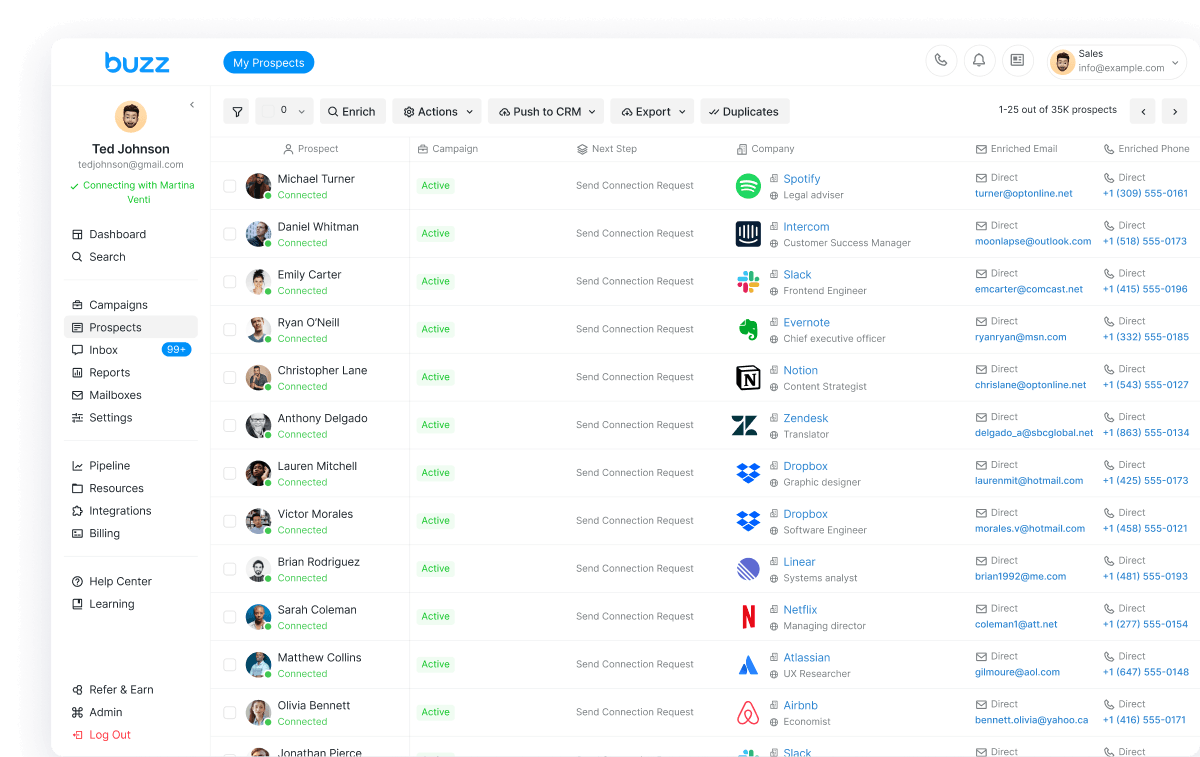
Buzz verifies email addresses as part of its data enrichment workflow, eliminating the need to juggle separate verification tools. When Buzz enriches a contact record, verification happens simultaneously—checking syntax, validating domains, confirming MX records, and performing SMTP verification before the data enters your CRM.
This integrated approach means you never work with unverified data. Every enriched email address Buzz provides has already passed multi-layer validation, protecting your sender reputation from the moment you start outreach.
Buzz goes beyond simple email verification to build complete prospect profiles with verified email addresses, direct phone numbers, accurate job titles and industry classification. The platform performs real-time verification during data capture and enrichment, preventing bad data from entering your workflow.
Best Practices for Email List Hygiene
Effective b2b sales email verification techniques extend beyond one-time validation to include ongoing list maintenance practices.
Implement Double Opt-In
Double opt-in requires subscribers to confirm their email address by clicking a link before they're added to your active outreach list. This extra step verifies both subscriber intent and deliverability.
Double opt-in is one of the best ways to avoid spam traps because automated bots and fake addresses can't complete the confirmation step.
Segment Verified vs. Unverified Contacts
Tag and separate validation status in your CRM to prevent mixing clean data with unverified imports. This segmentation lets you send high-stakes campaigns only to fully verified contacts while using lower-priority outreach to test questionable addresses.
Remove Inactive Subscribers Regularly
Purge contacts with 6-12 months of zero engagement as email providers convert abandoned addresses into recycled spam traps. An address that hasn't opened, clicked, or replied in a year is either invalid, abandoned, or belongs to someone who has no interest in your messages.
Never Buy or Scrape Email Lists
Purchased lists contain spam traps, outdated addresses, and non-consensual contacts that guarantee deliverability damage and legal risk. Beyond the technical problems, sending to purchased or scraped lists violates GDPR, CAN-SPAM, and most email service provider terms of service.
Measuring Success: Email Verification Metrics to Track
Tracking the right metrics helps you evaluate whether your b2b sales email verification techniques are delivering the expected ROI and protection.
Bounce Rate
Target bounce rates below 2% for healthy sending, with rates of 2-5% indicating problems that need immediate attention and above 5% requiring emergency intervention. Monitor bounce rate by campaign, list source, and time period to identify which data sources are introducing invalid addresses.
Deliverability Rate
Monitor inbox placement percentage as a leading indicator of sender reputation and verification effectiveness. Deliverability rate measures what percentage of sent emails actually reach the inbox rather than bouncing, getting filtered to spam, or being blocked entirely.
(Here are email deliverability best practices to avoid spam.)
List Accuracy and Decay Rate
Track the percentage of valid emails over time to determine re-verification frequency and measure data quality investments. Companies that address data decay report efficiency increases of over 300% because they stop wasting resources on contacts that no longer exist.
Bottom Line: Email Verification Protects Deliverability and ROI
Email verification is no longer a suggestion; it's the gatekeeper of your email deliverability. Think of validating email addresses as a brilliant financial move—because the cost of ignoring it makes verification look like a bargain. Offering a rock-solid 7:1 ROI, verification keeps your sender reputation out of the spam folder and ensures your outreach campaigns aren't just expensive exercises in futility.
Integrated solutions like Buzz streamline the verification process by combining email validation with data enrichment in a single workflow. Instead of managing separate tools for finding contacts, verifying emails, and enriching data, you get complete, verified prospect profiles ready for outreach—protecting your sender reputation while accelerating your sales process.
Stop guessing. Start sending with confidence.
Schedule your demo with Buzz and see how built-in email verification and data enrichment keep bad addresses out of your campaigns.