Stop Buying Tools and Start Fixing Your Funnel
If your Q2 or Q3 planning feels like a long budget meeting, you are not alone. Everyone is under pressure to grow pipeline, cut costs, and somehow do more with less. It is very tempting to fix slow lead flow by adding one more B2B lead generation tool to the stack.
We think there is a better first move. Instead of tearing everything down, run a full-funnel audit. Map tools, data, and KPIs across ToFu, MoFu, and BoFu, then line that up with who owns what and how handoffs work. The goal is simple: expose gaps, overlaps, and friction, so you can get more out of the tools you already pay for.
By the end, you will have a clear, CEO-ready checklist you can point to when someone asks, "Where is our funnel breaking and what should we fix first?" No drama, no giant rebuild, just clean, honest visibility.
Map Your Funnel Before You Touch a Single Tool
Before we talk software, we need a shared picture of your funnel. Start by writing down your stages in plain language for your sales motion, whether that is inbound, outbound, ABM, or a mix. For each stage, define what “progress” looks like in a way everyone can agree on:
- ToFu: Anonymous visitor to known, engaged contact
- MoFu: Engaged lead to qualified meeting or opportunity
- BoFu: Opportunity to closed-won deal
Once the stages are clear, document who owns each stage and how the handoffs work. The point is to remove ambiguity about responsibility so problems do not get blamed on “the funnel” when they are actually handoff issues:
- Marketing: traffic, content, forms, early nurture
- SDRs: first touches, qualification, meeting setting
- AEs: discovery, proposals, negotiations, close
- RevOps: process, systems, data quality
Next, write down what information each team expects to receive at a handoff. For example, SDRs may expect firmographic data and basic intent notes, while AEs may expect a full history of email, calls, and social outreach.
Finally, pick 3 to 5 KPIs per stage, such as reply rates, qualified meetings booked, stage conversion, and cycle time. These become your truth. You will judge B2B lead generation tools by how they help these numbers, not by how many shiny features they have.
Top-of-Funnel Audit: From Visitor to Engaged Prospect
At the top, your goals are simple: find the right people, earn their attention, and capture a clean way to talk with them again. That might be email, phone, or a social channel.
Start by listing every ToFu tool you use:
- Website forms and landing page tools
- Chat or chatbot tools
- Content syndication partners
- Paid media platforms
- List or data providers
- Cold email and basic social outreach tools
Then run a quick checklist across data, workflows, and KPIs. On the data side, confirm what contact and company data you capture at first touch, where enrichment happens (if it happens at all), and where you see duplicates, missing fields, fake emails, or deliverability issues. On the workflow side, trace how new contacts move into outreach sequences or nurture, and note where people still export CSV files, import them into email tools, or copy-paste into social messaging by hand. Finally, check whether your reporting covers the basics you actually need:
- Delivered emails and open or reply rates
- Form fill volume and quality
- Cost per lead by channel
- Coverage across your target accounts
Flag any tool that cannot give you clean, simple reporting on those basics. In many cases, the issue is not the tool itself; it is how it is wired to your CRM and other systems.
Middle-of-Funnel Audit: Nurture, Qualify, and Route Without Leaks
MoFu is where many teams spring leaks. Leads reply, then get lost in inboxes. SDRs juggle three different tools. Context goes missing between follow-ups. The goal here is one smooth flow from first reply to booked meeting.
List your MoFu tools:
- Nurture or marketing automation
- Email and multichannel sequencers
- Sales engagement platforms
- Dialers or call tools
- Meeting schedulers
- AI lead scoring or routing systems
Now check three areas: data, workflows, and KPIs. For data, identify which system is the “source of truth” for lead status and owner, where enrichment happens (and whether fields match your CRM), and whether you can see engagement history across email, phone, video, and social in one place. For workflows, map the path from first reply to booked meeting, then highlight where reps re-type notes, rebuild sequences, or have to chase missing firmographic data before they can qualify. For KPIs, ensure you can measure the conversion and speed metrics that reveal whether follow-up is truly healthy:
- Reply-to-meeting conversion
- Speed-to-first-touch and speed-to-second-touch
- MQL-to-SQL conversion
- No-show rates on meetings
Any tool that makes it hard to see one clean timeline of touches is adding friction. In warm months when teams are juggling travel and events, slow or messy follow-up can quietly drain pipeline.
Bottom-of-Funnel Audit: From Meeting to Revenue
At BoFu, more tools can actually slow deals down. AEs need complete context, clean records, and clear next steps, not extra admin. Your job here is to make sure deals move cleanly from meeting to close.
List BoFu tools:
- CRM
- Proposal and e-signature tools
- Forecasting and pipeline tools
- Call recording or analysis
- Sales intelligence for deal research
Run the same style of checklist across data, workflows, and KPIs. For data, confirm whether contact, account, and opportunity records are enriched and de-duplicated, and whether engagement data from earlier stages flows into the CRM, including email threads, call notes, and social outreach. Also check whether AEs trust what they see or keep private spreadsheets on the side. For workflows, look at how meetings, follow-ups, and proposals are triggered, how many tools an AE touches just to send a recap and set a reminder, and where approvals get stuck in slow manual steps. Then validate that you can measure outcomes that actually reflect deal health:
- Opportunity conversion by source
- Cycle length by segment or deal size
- Multi-threading depth inside accounts
- Win-loss reasons captured in a structured way
If a tool creates more activity but does not move these KPIs in a clear way, it is adding noise, not revenue.
Surface Gaps, Overlaps, and Optimize What You Already Have
Now pull the whole story together. Build a simple table for each stage with columns for tools, owners, primary use, key data fields, and covered KPIs. When you see it in one view, patterns jump out.
First, look for overlaps that create confusion, duplicated effort, or inconsistent reporting:
- Multiple sequencers or engagement tools doing the same thing
- Several data providers all feeding partial data
- Two or three places where messaging is written and stored
Then look for gaps where important work has no clear home, no automation, or no shared visibility:
- No clear owner for lead routing or territory rules
- No system that owns automated follow-ups after events or form fills
- No shared view of email deliverability across outbound teams
- No AI support for drafting, prioritizing, or summarizing
Finally, add the hidden costs by counting the hours people spend on manual work and cleanup. These time sinks rarely show up in tool price tags, but they quietly compound across the funnel:
- Exporting and cleaning lists
- Copying notes between tools
- Fixing sync errors or duplicates
- Rebuilding sequences from scratch in multiple places
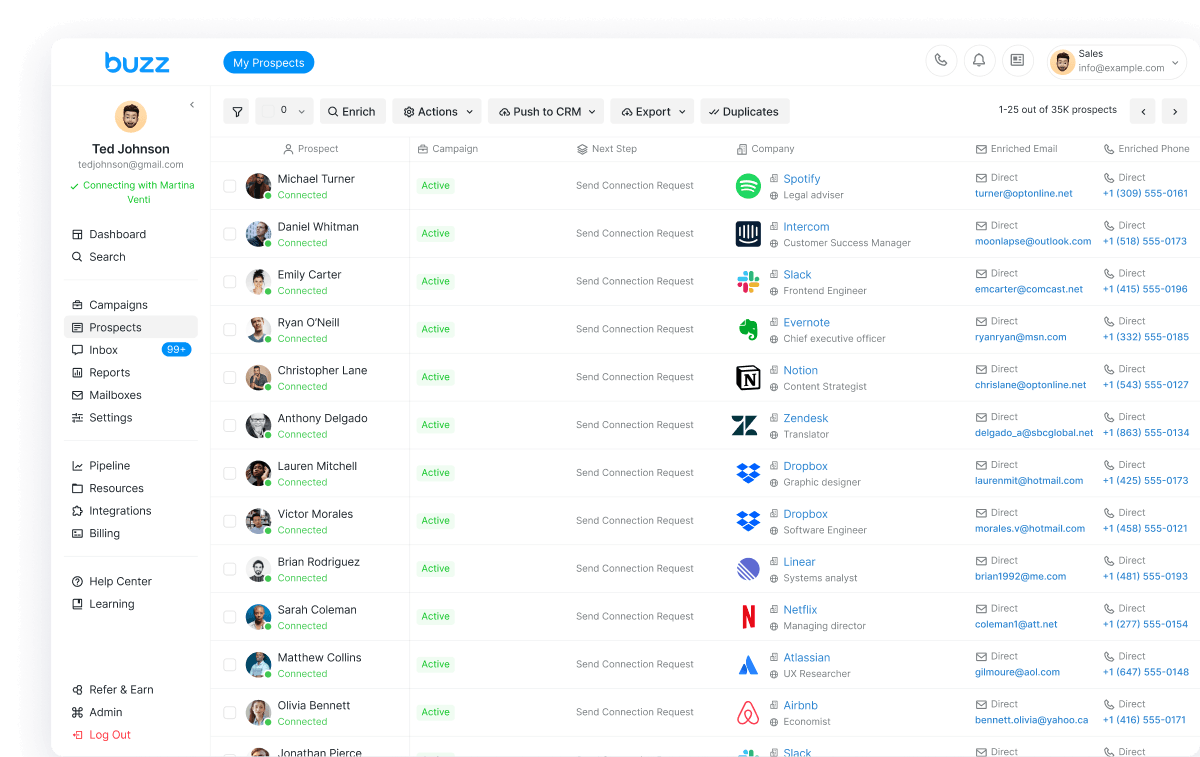
This is where a smaller, smarter stack wins. At Buzz AI, we built our platform to combine data enrichment, outreach automation, and AI-assisted workflows in one workspace, across email, phone, video, and social, so teams can improve email deliverability, scale social outreach, and remove a lot of that hidden drag without buying more point tools.
Turn Your Best Prospects Into Ready-To-Buy Opportunities
If you are ready to turn data into real sales conversations, explore our B2B lead generation tools and see how Buzz AI can plug directly into your existing workflows. We help you identify, prioritize, and nurture the accounts that actually match your ideal customer profile. Have questions or want to talk through your specific use case, reach out and contact us so we can map out the right approach together.