Most outbound teams don't have a targeting problem. They have a definition problem. Reps build lists, write sequences, and launch campaigns against accounts that look reasonable on paper but never convert.
An ideal customer profile fixes that. It is an account-level description of the B2B companies most likely to buy your product, retain long enough to generate real value, and expand over time. Getting the B2B sales ideal customer profile criteria right changes everything downstream, from list quality to reply rates to pipeline velocity. Getting them wrong means your team is running high-effort plays against low-probability accounts.
This guide walks through what an ICP is, what criteria to include, how to build one from your own data, and how to turn it into something your sales team actually uses every day.
TL; DR: (Key Takeaways)
- An ideal customer profile is an account-level description of the companies most likely to buy, retain, and expand. It is not a buyer persona.
- The core B2B sales ideal customer profile criteria fall into four categories: firmographic, technographic, operational, and exclusion.
- Build your ICP by segmenting your market, analyzing your best customers, extracting shared patterns, and validating with cross-functional teams.
- A specific ICP directly improves outbound email targeting, reply rates, and pipeline efficiency by ensuring reps spend time on accounts that actually convert.
- Revisit the profile quarterly. A stale ICP is only slightly better than no ICP at all.
What Is an Ideal Customer Profile?
An ideal customer profile is a detailed description of a company that is a perfect fit for your product or service. Salesforce frames it as a combination of behavioral, firmographic, and environmental characteristics that define which companies your sales team should prioritize.
Gartner defines the ICP similarly: the attributes of a prospective company most likely to buy and become a loyal and profitable customer. The keyword here is "company." An ICP is not about a person, a job title, or a department. It is about the “company account” itself.
For outbound sales teams, the ICP acts as a filter. It tells you which accounts belong on your target list and which ones don't.
Why ICPs Matter in B2B Sales
A well-defined ICP improves nearly every stage of the outbound sales process. Prospecting gets faster because reps know exactly what to look for. Qualification gets easier because you have clear criteria for scoring accounts.
The impact on email outreach is especially measurable. When your ICP is specific, reps can write emails that reference real pain points, relevant use cases, and timely triggers instead of sending broad templates to loosely matched lists. Reply rates and conversion rates both improve when every email lands in the inbox of someone at a company that genuinely fits your product.
Pipeline efficiency is where the impact compounds. When reps spend time on accounts that match your ICP, close rates go up, sales cycles shorten, and churn drops. Cognism notes that without a clear target audience, teams struggle to position products and services effectively.
B2B Sales Ideal Customer Profile Criteria
The B2B sales ideal customer profile criteria your team should evaluate fall into four categories: firmographic, technographic, operational, and exclusion. Together, they create a profile specific enough to drive real targeting decisions.
Firmographic Criteria
Firmographics describe the company itself: industry, employee count, annual revenue, geography, business model, and growth stage. A sales engagement vendor, for example, might target B2B SaaS companies with 50 to 500 employees, headquartered in North America, generating $5M to $100M in annual revenue.
Growth stage matters more than many teams realize. A pre-revenue startup and a Series C company with an established go-to-market motion have fundamentally different needs, budgets, and buying behaviors.
Technographic Criteria
Mutiny identifies firmographics and tech stack as the core pillars of a B2B ICP. The tools a company already uses tell you whether your product fits into their workflow or creates friction.
Relevant technographic criteria include which CRM the prospect uses, whether they have a sales engagement platform, what data enrichment tools they rely on, and whether their stack supports the integrations your product requires. Tech stack data is increasingly accessible through enrichment providers and is one of the most actionable ICP criteria because it directly affects implementation success and retention.
Operational and Buying Criteria
Operational criteria describe how a company works: team structure, process maturity, buying complexity, and specific pain points. Does the company have a dedicated SDR team? How mature is their outbound motion?
Buying triggers add a time dimension. A company hiring its first VP of Sales, closing a funding round, or expanding into a new market may have urgency that a similar company without those signals does not. For email outreach, timing a message to coincide with a buying trigger can be the difference between a reply and silence.
An average B2B software buying committee involves five to sometimes even ten decision makers. Understanding team structure at the account level helps reps plan multi-threaded outreach.
Exclusion Criteria
Exclusion criteria prevent reps from chasing accounts that look attractive but consistently fail to convert or retain. Mutiny gives practical examples: a company using an incompatible CRM, operating in an unsupported region, or lacking internal resources to implement your product.
Other common disqualifiers include companies below a viable contract value threshold, accounts in regulated industries where your product lacks compliance features, and organizations without a clear pain point your product addresses. Adding a "do not target" section to your ICP saves time and protects win rates.
Ideal Customer Profile vs Buyer Persona
HubSpot draws the line clearly: an ideal customer profile describes the company you want to sell to, while a buyer persona describes the individual people within that company who influence purchasing decisions.
The ICP answers "Which accounts should we target?" The buyer persona answers "Who inside those accounts should we talk to?" Both are necessary, but the ICP comes first. There is no point in crafting a persona for a VP of Sales if you haven't determined which types of companies that VP would work at.
Because B2B buying committees involve multiple stakeholders, you may need several buyer personas for a single ICP, each with different pain points and messaging needs. The ICP holds account-level criteria steady while personas handle person-level variation.
How to Create an Ideal Customer Profile
Building an ICP requires some CRM history and at least a few dozen customers. The process below works for most B2B teams.
1. Segment the Market First
The Wizly guide on LinkedIn makes a point many teams skip: segment your market before defining your ICP. If you average traits across all customers (different industries, sizes, use cases), you end up with a blended profile that describes no one well.
Group customers into meaningful segments based on vertical, company size, use case, or go-to-market model. Build a focused ICP for each cluster.
2. Analyze Best-Fit Customers
Within each segment, identify accounts with the best outcomes: highest retention, fastest sales cycles, strongest expansion revenue, lowest support burden. Look at the top 20% of customers driving the majority of your revenue and retention value as a starting point.
3. Identify Shared Patterns
Extract common attributes from your best-fit list across all four criteria categories. A pattern like "B2B SaaS, 100 to 300 employees, uses Salesforce CRM, has an SDR team of at least three, actively scaling outbound" is far more useful than "mid-market technology companies."
Document both the criteria and the evidence. If 80% of your best customers share a specific attribute, that is a strong signal. If it's 40%, it may be a nice-to-have.
4. Validate with Sales and Customer Teams
Sales reps know which accounts felt right and which dragged. Customer success teams know which accounts churn and why. RevOps can stress-test criteria against pipeline and conversion data. Run the draft ICP through these teams before finalizing. Avoid building the ICP in a silo.
5. Turn the ICP into a Working Document
The profile should translate directly into account scoring rules, list-building filters, qualification criteria, and messaging frameworks. For outbound teams, the ICP defines target list filters, informs lead scoring, and guides email sequences. When reps can map ICP criteria directly to email copy (referencing a prospect's tech stack, team structure, or trigger event), outreach feels relevant instead of generic.
Revisit the ICP quarterly or whenever your product, market, or customer base shifts meaningfully.
How Buzz Can Help with ICP-Based Email Outreach
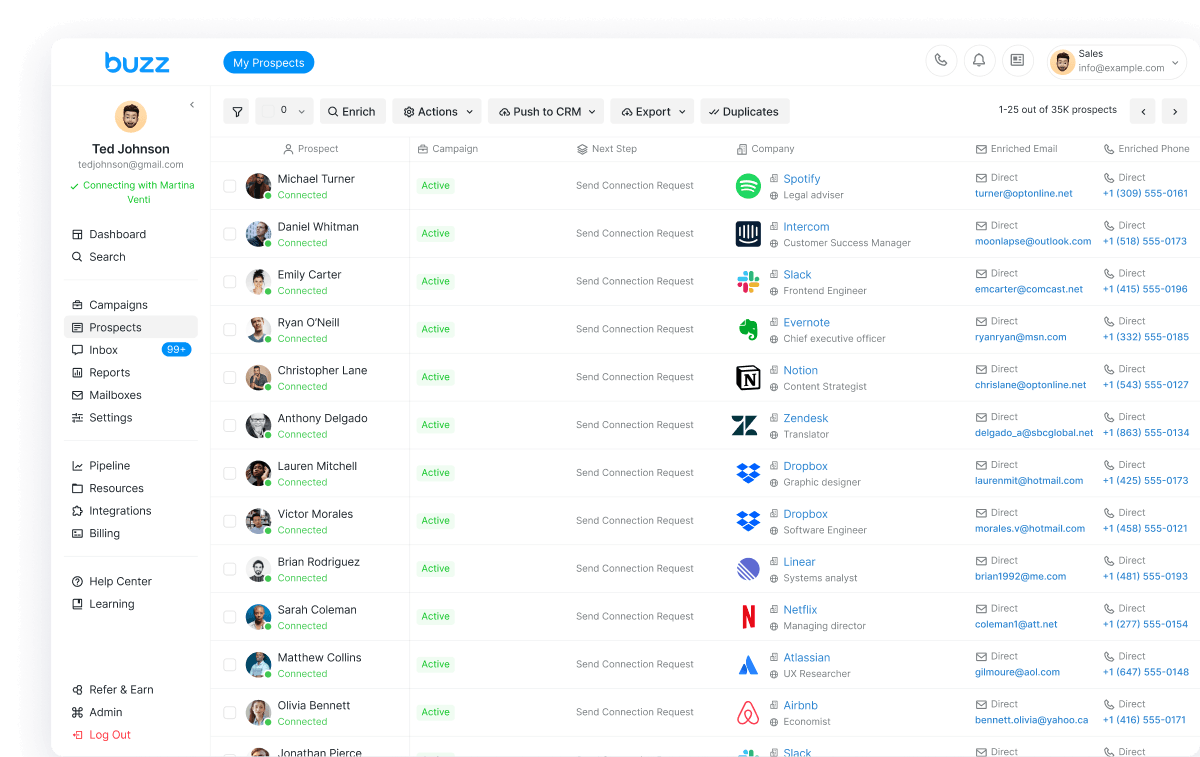
Once your ICP is defined, the next challenge is finding matching accounts and reaching them with relevant messaging at scale. Buzz is an AI-powered sales engagement platform with access to over 250M contacts and 11M companies, making it possible to filter and build target lists based on the firmographic, technographic, and operational criteria in your ICP.
On the outreach side, Buzz can automatically craft personalized messages based on prospect and account data, and dynamically adjust targeting as new signals emerge. Email sequences, Social messages, and follow-ups all stay aligned to ICP criteria without manual list management.
Ready to see how Buzz helps teams identify and enrich best-fit accounts? Get started with Buzz today.
Ideal Customer Profile Template
Adapt these fields to your product, market, and sales motion.
Company Attributes
- Industry/Vertical:
- Employee count range:
- Annual revenue range:
- Geography/Region:
- Business model:
- Growth stage:
Tech Stack
- CRM in use:
- Sales engagement tools:
- Data enrichment or intent tools:
- Integration requirements:
Team and Process
- Sales team structure:
- Outbound maturity level:
- RevOps or sales ops support:
Pain Points and Triggers
- Primary pain points:
- Buying triggers (hiring, funding, expansion, tool replacement):
Exclusion Criteria
- Incompatible tech stack:
- Unsupported region:
- Below minimum contract value:
- Missing internal resources:
- No clear pain point alignment:
Fill this template with data from your actual customer base. The exclusion section is just as important as the positive-fit fields.
Ideal Customer Profile Examples
Example 1: Sales engagement platform targeting mid-market SaaS
- Industry: B2B SaaS, 50 to 500 employees, $5M to $75M ARR
- Geography: North America, UK, Western Europe
- Tech stack: Salesforce or HubSpot CRM, at least one outbound tool
- Team: Dedicated SDR team of 3+, at least one RevOps hire
- Pain points: Low reply rates, manual prospecting, fragmented multi-channel execution
- Triggers: New sales leadership hire, Series B+ funding, market expansion
- Exclusion: No outbound motion, incompatible CRM, fewer than two SDRs, ACV below $8K
Example 2: Data enrichment provider targeting agencies
- Industry: B2B lead gen or growth marketing agencies, 10 to 100 employees, $1M to $20M
- Geography: US and Canada
- Tech stack: Any major CRM, active outbound sequencing tools
- Pain points: Poor data quality, high bounce rates, time-intensive list building
- Triggers: New client wins requiring fresh data, scaling beyond manual research
- Exclusion: Inbound-only or paid-media-only agencies, no outbound delivery capability
Both examples are narrow enough that a rep can check a prospect account against each criterion and decide in under a minute whether it is worth pursuing.
Common ICP Mistakes to Avoid
- Building one giant ICP for the entire market
If you sell to mid-market SaaS and enterprise financial services, blending them into a single profile produces criteria too broad to be useful. Build separate ICPs for distinct segments. - Skipping exclusion criteria
Without documented disqualifiers, reps waste cycles on accounts that look good in a list but consistently stall or churn. - Confusing ICP with buyer persona
The ICP defines the account. The persona defines the people. Account-level criteria. - Letting the ICP go stale
Review and update the profile at least quarterly. Your customer base changes, and the ICP should change with it. - Relying on assumptions instead of data
Validate criteria against CRM data, win/loss analysis, and customer interviews. The best ICPs are built from evidence.
Build Smarter Outbound With ICP
Better outbound targeting starts with a well-defined ideal customer profile. The process is straightforward: segment your market, study your best customers, extract the patterns, validate with your team, and put the profile to work in daily prospecting.
The ICP should inform every list you build, every account you score, and every email sequence you write. Teams that treat it as an operational tool consistently see stronger pipeline quality. Teams that skip the work spend more time on accounts that were never going to close.
Want to build better target lists and run more relevant outbound campaigns? Explore Buzz to see how teams use AI-powered prospecting and multi-channel outreach to turn their ICP into pipeline.