each worth $50,000. Six months of work, dozens of discovery calls, countless follow-ups. Then one closes. Then another. In two weeks, they've earned more commission than most reps make in a quarter.
That's high-ticket sales. Products or services priced at $2,000 or more require a completely different approach than transactional selling. You're not moving volume. You're building trust, navigating buying committees, and proving ROI to skeptical executives who've seen every pitch deck in existence.
This guide walks through the frameworks, strategies, and tools that turn cold prospects into closed deals worth five or six figures.
What Is High-Ticket Sales and Why It Matters
High-ticket sales typically start at $2,000 and can extend well into six figures. Some industries define high-ticket as $1,000+, while enterprise deals often range from $5,000 to $100,000+. The price tag alone doesn't define the category. What matters is the complexity: longer decision cycles, multiple stakeholders, and the need for consultative selling rather than transactional closing.
The math works differently here. Close one $50,000 deal and you've matched the revenue of fifty $1,000 transactions, without the overhead of managing fifty separate customer relationships. High-ticket closers achieve significant income goals with fewer transactions, making it one of the most efficient revenue models in B2B sales.
But efficiency comes with a trade-off. These deals take time. Sales cycles typically range from 3-18 months, depending on complexity, and 74.6% of B2B sales to new customers take at least 4 months to close.
The Psychology Behind High-Ticket Buying Decisions
High-ticket buyers don't purchase features. They invest in transformation and measurable outcomes. A CFO evaluating a $75,000 software platform isn't thinking about the user interface. They're calculating whether it will reduce operational costs by 20% or improve forecast accuracy enough to justify the investment.
Customers expect superior quality, exceptional service, and a personalized buyer journey with high-ticket purchases. They're not just buying a solution. They're betting their budget, their reputation, and sometimes their job security on your ability to deliver results.
Trust becomes the currency. High-ticket sales psychology centers on understanding that buyers invest in outcomes, not products, making both emotional and logical validation critical throughout the sales process.
High-Ticket vs. Transactional Sales: Key Differences
Transactional sales move fast. A prospect visits your website, reads a few pages, maybe watches a demo video, and converts within days or weeks. The relationship is secondary to the product.
High-ticket sales flip this model. The average time from conducting initial research to deal closure is 379 days, and buying committees now consist of 10-11 stakeholders on average. Each stakeholder brings different priorities, concerns, and veto power.
You're not just selling. You're educating, consulting, and building consensus across departments that may have competing interests. The VP of Sales wants faster pipeline velocity. The CFO wants cost containment. IT wants security guarantees. Your job is to speak all three languages fluently.
The High-Ticket Sales Process: From Prospecting to Close
The six-step high-ticket sales process includes: identify and qualify leads, build rapport and trust, conduct deep-dive discovery calls, present tailored offers, handle objections thoughtfully, and close with clarity and confidence. Each stage requires different skills and different levels of patience.
The process isn't linear. You'll loop back to discovery after presenting your solution. You'll rebuild rapport when a new stakeholder joins the buying committee three months into the cycle. The framework provides structure, but execution demands adaptability.
Most deals don't fail at the proposal stage. They die between diagnosis and decision due to unclear value or positioning issues. That's why the middle stages—discovery and value presentation—matter more than the close itself.
Lead Identification and Qualification Frameworks
Two frameworks dominate B2B qualification: BANT and MEDDIC. BANT (Budget, Authority, Need, Timeline) focuses on purchase readiness and works best for straightforward, transactional sales with shorter cycles. It's fast, simple, and effective when you're dealing with single decision-makers.
MEDDIC (Metrics, Economic Buyer, Decision Criteria, Decision Process, Identify Pain, Champion) provides comprehensive qualification for complex enterprise sales. It treats qualification as an ongoing process rather than a one-time checkpoint. You're constantly validating whether the deal is real, who holds budget authority, and whether you have an internal champion fighting for you.
The results speak clearly. Companies using MEDDIC report up to 25% increase in win rates because they're qualifying deeper and aligning better with buyer needs throughout the entire cycle.
Discovery Calls: The 80/20 Listening Rule
Discovery calls should follow an 80/20 rule: listen 80% of the time and talk 20% to understand client needs deeply. Most reps get this backwards. They pitch solutions before understanding problems, answer questions nobody asked, and mistake talking for selling.
High-ticket discovery goes beyond surface requirements to uncover business challenges, quantify the cost of inaction, and identify all buying decision stakeholders. You're mining for specific metrics: revenue impact, cost savings, efficiency gains, risk reduction potential.
Ask about the last time they tried to solve this problem. Who championed that initiative? Why did it fail? What would happen if they did nothing for another year? These questions reveal whether you're dealing with a nice-to-have or a business-critical priority.
Presenting Value-Based Solutions
Feature lists lose high-ticket deals. Value-based selling requires connecting solutions to specific business outcomes like revenue growth, market expansion, operational efficiency, or competitive advantage. You're not selling software. You're selling 30% faster time-to-market or $2M in annual cost savings.
Instead of saying "Our CRM helps manage contacts," effective positioning states "Our CRM helps sales teams close 30% more deals in 90 days". The difference is measurable impact versus generic capability.
Build your business case around their numbers, not yours. If they told you in discovery that manual reporting costs 40 hours per month across their team, show exactly how your solution reclaims those hours and what that time is worth at their average salary.
Lead Generation Strategies for High-Ticket Sales
High-ticket lead generation prioritizes quality over volume. You're not trying to generate 10,000 MQLs. You're trying to identify 100 accounts that match your ideal customer profile and have active buying intent.
Content marketing, whitepapers, webinars, blogs, and social selling attract and qualify ideal prospects across channels like LinkedIn and Google. Each content piece serves as a filter, self-selecting prospects who care enough about the problem to invest time learning about solutions.
The omnichannel approach matters. 73% of consumers make buying decisions through several channels, so a prospect might discover you through a LinkedIn post, consume a webinar, download a whitepaper, and then request a demo. Each touchpoint builds familiarity and trust.
LinkedIn Prospecting: Where 80% of B2B Leads Live
LinkedIn generates 80% of B2B leads online, making it the primary platform for professional prospecting. The network effect is powerful: your ideal prospects are already there, they're open to business conversations, and the platform provides rich data about job changes, company growth, and hiring activity.
The challenge is standing out. Everyone's prospecting on LinkedIn now. Generic connection requests get ignored. Copy-paste messages get deleted. You need a system that scales outreach while maintaining the personalization that actually gets responses.
This is where automation becomes essential. Manual prospecting caps out at maybe 50 quality touches per day. Automated workflows can handle hundreds while still feeling personal because they're triggered by relevant signals—a job change, a funding announcement, a new hire in a key department.
Data Enrichment: The Foundation of Targeted Outreach
You scrape a list of 1,000 prospects from LinkedIn. Half have incomplete profiles. Email addresses are missing. Job titles are vague. Company revenue data is nonexistent. Without enrichment, this list is nearly worthless.
Data enrichment enhances business data by appending demographics, firmographics, contact information, and behavioral data to existing records. It transforms "John Smith, VP at TechCo" into a complete profile with verified email, direct phone number, company size, revenue range, technology stack, and recent funding activity.
The difference between enriched and raw data is the difference between personalized outreach and spam. With enriched data, you know John just raised a Series B, hired 30 people last quarter, and uses Salesforce. Your message can reference these facts instead of leading with generic value props.
Real-time data enrichment and verification reduce bounce rates and improve deliverability compared to static enrichment. Email addresses decay at roughly 22% per year as people change jobs, companies get acquired, and domains shift. What worked six months ago bounces today.
Poor data quality wastes more than time. It damages sender reputation, which affects whether future emails even reach the inbox. 71% of recipients ignore cold emails because they lack relevance, and irrelevance often starts with bad data leading to mistargeted outreach.
Cold Email Outreach: Best Practices for 2025
The average cold email gets a 4.1% reply rate, but top performers see 6× higher response rates through differentiated approaches. The gap between average and excellent is massive, and it comes down to relevance, timing, and technical execution.
61% of decision makers prefer cold email over other outreach methods, with only 10% favoring cold calls. Email gives prospects control. They can read and respond on their schedule, forward to colleagues, and review your claims before replying. That makes it ideal for high-ticket sales where decisions involve multiple stakeholders.
The challenge is standing out. Executives receive dozens of sales emails daily. Most get deleted within seconds based on subject line alone. Your job is to make those first three seconds count.
Personalization at Scale: Going Beyond Name Tokens
Generic templates are easily spotted; successful emails reference specific details about the prospect's company, role, or recent activity. Inserting {{FirstName}} and {{Company}} isn't personalization. It's mail merge with delusions of grandeur.
Context-driven personalization (referencing hiring activity, funding, role changes, product launches) dramatically outperforms basic name/company personalization. "I noticed you just opened a Dallas office and are hiring 5 SDRs" shows you did homework. "I help companies like yours grow faster" shows you sent the same email to 500 people.
The trick is doing this at scale. You can't manually research every prospect when you're reaching out to hundreds per week. You need enrichment data that surfaces these signals automatically and templates smart enough to weave them into messages that feel individually crafted.
Email Warm-Up and Deliverability Best Practices
Email warm-up and using separate sending domains protect primary domain reputation. Never send cold outreach from your primary business domain. If your main domain is company.com, set up outreach.company.com or similar for prospecting.
New domains and mailboxes need warming before high-volume sending. Start with 10-20 emails per day and gradually increase over 2-4 weeks. Limit cold outreach to under 100 emails per mailbox per day to maintain sender reputation and avoid spam filters.
Technical setup matters as much as content. Configure SPF, DKIM, and DMARC records correctly. Monitor bounce rates and spam complaints religiously. One bad campaign can tank your deliverability for months.
Follow-Up Cadence and Sequence Length
Cold email campaigns with 4-7 emails in a sequence receive 27% response rates, while campaigns with fewer follow-ups only achieve 9%. Most replies come from follow-ups, not initial emails. Persistence wins.
For B2B cold outreach, the best practice is 3 emails total per prospect: 1 initial email, 1 follow-up after 3 days, 1 final follow-up 6-7 days later. Space them enough to avoid annoyance but close enough to stay top of mind.
Each follow-up should add value, not just say "bumping this up in your inbox." Share a relevant case study in email two. Link to a helpful resource in email three. Give prospects a reason to engage beyond "did you see my last email?"
How Buzz Streamlines High-Ticket Sales Prospecting
Here's the problem with most sales tech stacks: you need one tool for social prospecting, another for lead scraping, a third for data enrichment, and a fourth for email automation. Each tool has its own login, its own data format, and its own quirks. You spend more time managing integrations than talking to prospects.
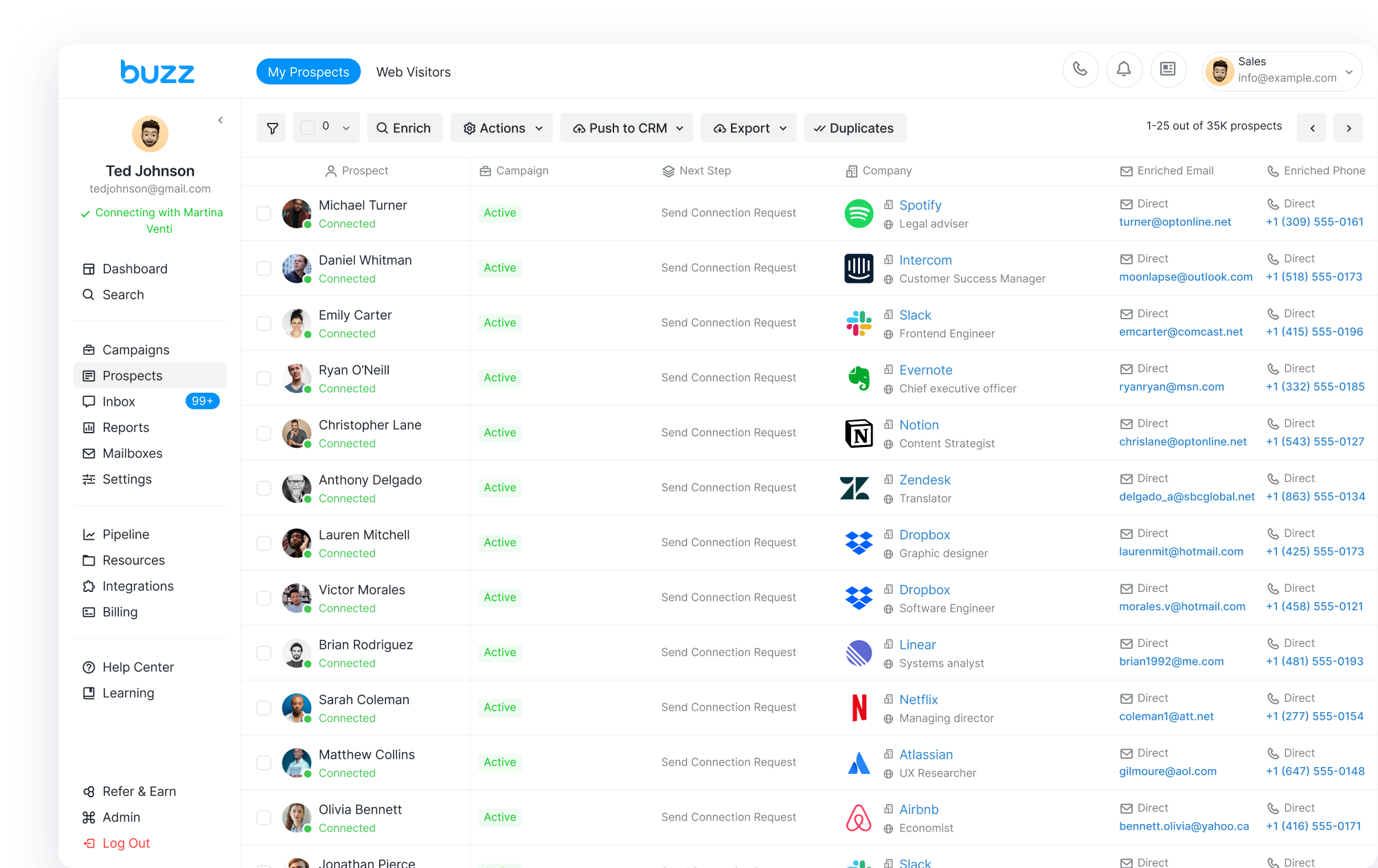
Buzz solves this by combining social outreach, lead scraping, data enrichment, and cold email automation into a single platform built specifically for high-ticket sales teams. Instead of juggling separate tools, you move from prospect identification to first conversation without switching platforms.
The platform addresses the core challenge in high-ticket prospecting: finding the right people, getting accurate contact information, and reaching them with personalized messaging at scale. For teams serious about building predictable pipeline in competitive markets, Buzz provides the automation and intelligence needed to compete without sacrificing the personalization that high-ticket deals require.
Social Outreach and Lead Scraping with Buzz
Buzz automates social prospecting from various sources to build targeted prospect lists based on your defined ideal customer profile (job title, company size, industry, location, tech stack). With Social Outreach, it finds prospects via Social Sales Navigator, eliminating manual research. Buzz's automation manages connection requests, message sequences, and profile engagement safely, running multi-step campaigns with automatic follow-ups to maintain a full pipeline with minimal effort.
Data Enrichment for Better Targeting
Buzz's real-time data enrichment appends verified firmographic and contact data (email, phone, revenue, employee count, tech stack) to all imported or discovered prospects. This accurate, current data is crucial for high-ticket sales, preventing wasted outreach. Enriched data allows for sophisticated segmentation and personalization (e.g., tailoring sequences for recently funded vs. bootstrapped companies), significantly boosting response rates over generic outreach.
Cold Email Automation That Converts
Buzz automates and personalizes high-ticket email sequences at scale, handling technical setup like domain configuration and mailbox warming to maximize deliverability. The platform uses dynamic tokens to reference specific prospect data (e.g., funding, hiring) for individually crafted emails. Buzz proactively monitors deliverability metrics, so that you can adjust sending patterns to protect domain reputation and ensure messages reach decision-makers. In high-ticket sales, this reliable deliverability is crucial.
If you want to stop juggling tools and start booking real high-ticket conversations faster, Buzz is worth a look.
Measuring and Optimizing Your High-Ticket Sales Performance
A win rate below 30% on qualified opportunities indicates something is broken in the sales process. Maybe you're qualifying poorly and chasing deals you can't win. Maybe your value proposition isn't resonating. Maybe you're losing to a specific competitor consistently.
Metrics provide the feedback loop needed for improvement. Without data, you're guessing about what works. With data, you can identify exactly where deals stall and test solutions systematically.
The key is tracking metrics that drive action. Vanity metrics like total pipeline value feel good but don't reveal what to fix. Conversion rates by stage, time in stage, and loss reasons point to specific problems with specific solutions.
Key Metrics and Conversion Benchmarks
On average, 13% of leads convert to opportunities (84 days), and only 6% of opportunities convert to deals (18 days). These benchmarks help you assess whether your funnel is healthy or leaking revenue.
If your lead-to-opportunity conversion is 8% instead of 13%, you're either attracting poor-fit leads or your qualification process is weak. If your opportunity-to-deal conversion is 3% instead of 6%, you're likely losing deals in the proposal or negotiation stages.
Track response rates by outreach channel. Email might generate 5% response rates while LinkedIn messages get 15%. That data tells you where to invest more effort. Monitor time-to-close by deal size. Maybe $25K deals close in 90 days while $100K deals take 180 days. That helps with forecasting and resource allocation.
High-Ticket Sales Reward Precision, Not Volume
High-ticket sales isn’t about hacks or heroics. It’s about discipline. Clear ICPs, sharp discovery, relevant outreach, clean data, and a system that lets you show up consistently without burning out. The reps and teams who win aren’t louder or luckier. They’re more deliberate. If you build a process that prioritizes relevance over volume and value over velocity, the deals compound. One closes, then another, then suddenly the dashboard starts telling a very different story.
Ready to close high-ticket sales? Try Buzz for free to see how it can transform your pipeline.