Why CFOs Are Rebuilding the Revenue OS Now
Revenue leaders are no longer rewarded for raw growth at any cost. Boards are asking a sharper question: what is the real return on every dollar we spend on sales and marketing? That puts CFOs right in the center of how go-to-market teams work, not just how they report numbers at quarter-end.
When we say Revenue OS, we mean a clear, connected operating system for revenue. It links sales intelligence, engagement, and reporting so every rep, channel, and program is measured on real outcomes like pipeline, win rate, and bookings. From a CFO point of view, the goal is not to stack more tools, it is to own a model that shows revenue yield per person and per dollar.
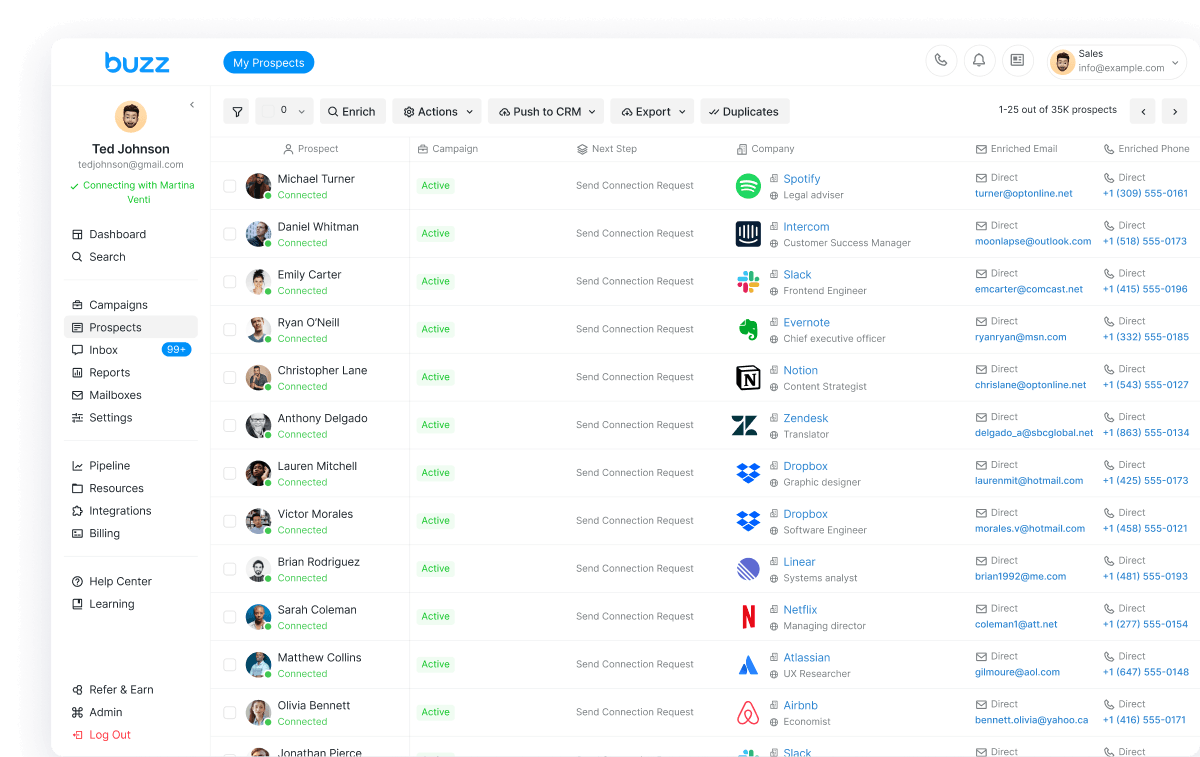
Sales teams used to chase more activity. Now finance, RevOps, and GTM leaders need to chase better yield from the activity they already have. An all-in-one sales engagement and sales intelligence platform like Buzz AI can sit at the center of that Revenue OS, giving one place to run outreach and one place to measure it, without asking finance leaders to wade through technical details.
Designing a CFO-Grade Revenue OS Model
A good Revenue OS starts with a simple idea: treat your go-to-market engine like a financial system. You have inputs, throughput, and outputs that all tie together.
Inputs:
- Headcount for SDRs, AEs, marketing, and CS
- Tools and sales intelligence platforms
- Programs like events, ads, and outbound campaigns
Throughput:
- Touches across email, calling, social outreach, and video
- Meetings booked and held
- Opportunities created and advanced
Outputs:
- Pipeline value
- Closed revenue and margin
- Net revenue retention
To make this work, you need clear data entities. At a minimum, that means Account, Contact, Lead, Opportunity, Activity, and Attribution Touch. Sales intelligence platforms enrich these records with firmographic, technographic, and intent data so your conversion assumptions are based on stronger signals, not guesswork.
Ownership also has to be plain and written down. A simple model that many teams follow looks like this:
- Finance owns the model, targets, and core assumptions
- RevOps owns the tech configuration, routing, and data quality
- GTM leaders own performance, coaching, and execution
This split keeps everyone aligned when pipeline or bookings miss plan. People argue less about whose system is right and more about which levers to pull. Mid-year planning is a great time to rebuild this model, while there is still room to course correct before annual budgets lock in.
Instrumenting Every Buyer Touch Across Channels
Once the model is clear, the next step is instrumentation. We want every buyer touch, across every channel, to turn into a trackable event that flows back into the CRM.
The full engagement journey usually includes things like:
- Inbound form fills and demo requests
- Outbound email sequences and one-off emails
- Outbound and inbound calling
- Social messaging and connection requests
- Short video messages sent to prospects
A Revenue OS turns all of these into timestamped, attributable events that link to Accounts, Contacts, and Opportunities. When a platform like Buzz AI unifies email outreach, calling, social messaging, and enrichment, finance teams no longer have to chase five reports from five tools just to answer one question.
From a CFO lens, a few practical metrics matter most:
- Reply rates and meeting rates by channel
- Stage-to-stage conversion from lead to opportunity to closed-won
- CAC by channel, program, or segment
- Multi-touch attribution that credits both marketing campaigns and sales actions
When sales intelligence data, engagement data, and outcome data all live in one Revenue OS, you get a self-correcting system. As more activity runs through it, your model learns which segments, messages, and channels actually pay off, and you can adjust plans with more confidence.
Setting SLAs, Guardrails, and Clear Ownership
Good data without clear rules quickly turns messy. That is where SLAs, guardrails, and ownership come in. The Revenue OS becomes the backbone that shows whether each team is keeping its side of the deal.
Typical cross-functional SLAs include:
- Marketing to sales: lead response time, lead quality definitions, and follow-up steps
- SDR to AE: meeting quality criteria and expected prep notes
- Sales to CS: handoff timing, documentation, and implementation readiness
Behind those SLAs sits data and process ownership. Someone has to own:
- Field definitions and picklists
- Enrichment rules and data refresh schedules
- Sequence templates, contact rules, and throttles
- Territories, routing logic, and account assignment
Central governance across platforms like Buzz AI and the CRM reduces the risk of “shadow processes,” where each region or manager runs their own playbook in a silo. Regular governance rhythms help, such as a monthly revenue council, quarterly SLA reviews, and exception reports for unworked leads, stale opportunities, or over-sequenced accounts.
For a CFO, this is not only about performance. Clean, governed engagement data supports audit-ready revenue recognition, accurate commissions, and forecasts that can be defended to the board with less stress.
Closing the Loop on Revenue Attribution Across GTM Teams
Closed-loop attribution sounds complex, but the idea is simple. Every meeting, opportunity, and dollar of revenue should roll up to specific campaigns, sequences, channels, and actions, not just a last-touch marketing field.
A Revenue OS helps by:
- Capturing both outbound and inbound activity in one place
- Enriching contacts so you know who is actually in the deal
- Syncing outcomes like meetings, stages, and win/loss back to the CRM
With that in place, you can give CFO-ready views such as:
- ROI by channel, like email vs social outreach vs calling
- ROI by sequence type or outbound motion
- ROI by segment, region, or vertical
- Incremental pipeline and bookings tied to sales intelligence programs
This is what makes budget talks more grounded. Attribution data supports reallocating spend away from low-yield channels and toward higher-yield programs going into the second half of the year. CAC and payback periods get better because you are not guessing which activities work, you are seeing it.
Turning Your Sales Intelligence Stack Into a True Revenue OS
Pulling this together, the CFO playbook looks straightforward on paper: design the model, instrument every touchpoint, set SLAs and ownership, and close the loop with multi-touch attribution across all GTM teams. The hard part is getting tools, process, and people aligned around one Revenue OS instead of a loose collection of disconnected systems.
A simple roadmap many teams follow:
- First 30 days: audit current tools, data flows, and definitions for Accounts, Leads, Opportunities, and Activities
- Next 60 days: standardize instrumentation, routing, sequences, and enrichment rules, plus stand up governance cadences
- By 90 days: roll out clear, standardized executive and frontline reports that tie activity to pipeline and revenue
Sales intelligence platforms become the foundation of this Revenue OS when they are tied tightly to engagement and attribution. At that point, they are no longer just “nice to have data,” they are a direct driver of pipeline, conversion, and net revenue retention. A unified platform like Buzz AI can help bring enrichment, outreach, and analytics together in one place so finance and GTM leaders share the same clear view of how revenue is actually created.
Unlock Smarter Revenue Growth With AI-Powered Insights
If you are ready to turn noisy data into clear, actionable direction for your sales teams, our sales intelligence platforms are built to help you do exactly that. At Buzz AI, we combine advanced AI with your real-world sales workflows so you can prioritize the right accounts, personalize outreach, and forecast with greater confidence. Talk with our team today to explore the best setup for your organization or contact us to schedule a tailored demo.