Quick answer: An AI BDR is AI software that does business development rep work: it finds prospects, sends outreach, follows up, handles replies and books meetings. AI SDR and AI sales agent mean much the same thing. An AI employee is the same idea sold as a full role. Buzz's AI Employee runs email, LinkedIn and call outreach.
Search for "AI BDR" and you get a wall of vendor homepages, each using a different name for the same thing. This guide sorts out the terms, shows what an AI BDR actually does in a day, compares the cost with a human hire, and is honest about where people still win. If you want the background first, read what an AI employee is.
Quick definitions: AI SDR, AI BDR, AI sales agent, AI employee
- AI SDR (sales development rep): AI that prospects, reaches out and books meetings for your closers. The most common name for the category.
- AI BDR (business development rep): the same job, often with a lean toward cold outbound and new markets. Most AI BDR platforms and AI SDR platforms do the same work.
- AI sales agent: a wider term. It can mean an AI that prospects, but also one that answers website chat, qualifies inbound leads or helps reps on live deals.
- AI employee: an AI hired for a named role on your team, such as SDR, with its own targets, playbook and results. Buzz calls its AI SDR an AI Employee.
The short version: the label matters less than the work. When you compare AI BDR software, ask what it does on its own, which channels it runs and who approves what gets sent.
What an AI BDR does day to day
A good AI BDR agent runs the same loop a human BDR does, without the hours of manual work in between:
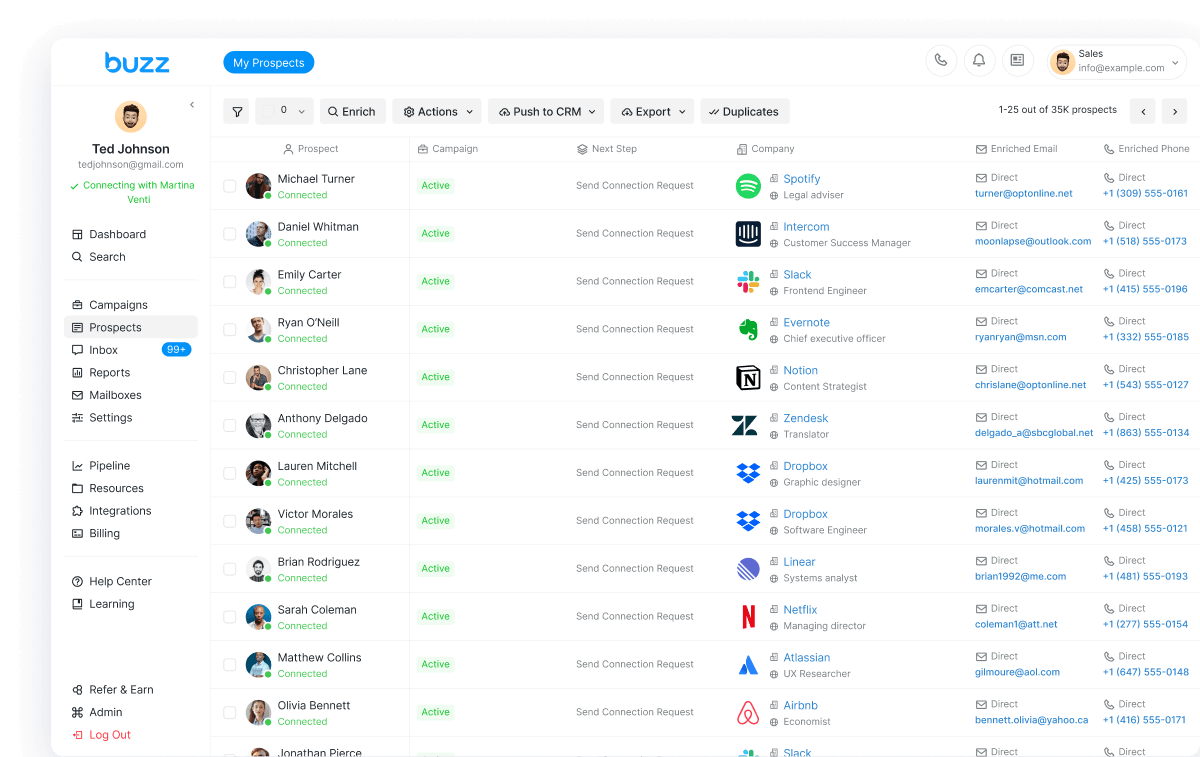
- Learns your business. It reads your website and offer so it knows what you sell, who you sell to and why they buy.
- Builds the list. It finds people who match your ideal customer profile by job title, industry, company size and region.
- Writes the outreach. Each prospect gets a personalized message, plus follow-ups.
- Runs the channels. Email, LinkedIn and calls, in one sequence, so a prospect who ignores email can still be reached.
- Handles replies. It answers questions and objections, and chases prospects who go quiet.
- Books the meeting. It puts the meeting straight on your rep's calendar.
Older bdr software, such as sales engagement tools, helps a human do steps 3 and 4 faster. An AI BDR platform aims to run the whole loop, with a person checking in rather than doing every step.
AI BDR vs human BDR: cost and coverage
A human SDR earns $80,000 a year in on-target pay at the median (The Bridge Group, 2025) and costs $120,000 to $164,000 a year fully loaded once benefits, tools, management time and recruiting are counted. That is the number most AI BDR budgets are measured against. A new hire also needs months to ramp before they book meetings at full speed.
| Human BDR | AI BDR | |
|---|---|---|
| Yearly cost | $80,000 on-target pay at the median; $120,000 to $164,000 fully loaded (The Bridge Group, 2025) | Software subscription; pricing models vary by vendor (per seat, per credit or per prospect) |
| Time to start | Hiring plus months of ramp | Days, or minutes for setup on some tools |
| Hours | Working hours, minus meetings, training and time off | Runs around the clock |
| Channels | Whatever the rep has time for | Email, LinkedIn and calls in parallel, depending on the tool |
| Judgment on complex deals | Strong | Limited; best paired with a human |
For a full breakdown of AI SDR pricing models and hidden costs, read how much an AI SDR costs. For a side-by-side of roles, see AI SDR vs human SDR.
Where humans still win
- Complex, high-value deals. Senior buyers with many stakeholders still expect a person who can read the room.
- Live conversations. Discovery calls, negotiation and tricky objections need human judgment.
- Strategy. Deciding which market to enter, which message to test and when to stop a campaign is a human call.
- Quality control. Someone should check targeting and messages, especially in the first weeks.
The teams that get the most from an AI BDR treat it as a teammate: the AI does the volume, and people spend their time on the conversations that close.
What Buzz's AI Employee runs
Buzz's AI Employee is an AI SDR for email, LinkedIn and call outreach. Here is what it covers, based on Buzz's AI Employee page and help center:
- Research: it reads your company website and builds a picture of your offer, pricing, ideal customer profile and goals.
- Prospects: it finds people who match your ideal customer profile, backed by a 250M+ contact database with data enrichment.
- Campaigns: it creates five multichannel campaigns across LinkedIn and email for you to review, edit and launch, with a personalized message for every prospect.
- Replies: it handles questions and objections, and re-engages prospects who leave you on read.
- Meetings: it books meetings in Calendly. It works with HubSpot and Pipedrive too.
- Control: choose Manual Approval to approve messages before they go out, or Automatic to let your AI Employee handle the conversation.
Price: AI Employee is Custom (talk to sales). It includes 5,000 credits per seat a month, with a 2-seat minimum. If you would rather start self-serve, Buzz Core is $79 per seat a month, billed monthly, with LinkedIn and email outreach, phone calling and voicemail drops. See every plan on the Buzz pricing page.
How to hire one in about 15 minutes
Buzz says an AI Employee takes around 15 minutes to onboard, compared with three to six months for a typical sales rep. The setup in Buzz's help center looks like this:
- Add your website. The AI Employee researches your company in about 30 seconds, and you check what it found.
- Set targeting. Pick job titles, region, industries and company size.
- Set the objective. Describe the problem you solve, your solution and why prospects should care, then choose language and tone.
- Add proof. Add up to three case studies, free offers and a Q&A your AI Employee can use in replies.
- Connect Calendly and choose Manual Approval or Automatic.
- Review and launch the five campaigns it creates.
For a step-by-step outbound plan, KPIs and modes, read how to hire an AI employee for sales outbound.
Ready to see it? Hire your AI Employee: talk to sales, or start free on Buzz Core.
FAQ
What is an AI BDR?
An AI BDR (AI business development representative) is AI software that does the top-of-funnel work a human BDR does: it finds prospects that fit your ideal customer profile, writes and sends outreach, follows up, answers replies and books meetings for your account executives. The best AI BDR software runs more than one channel, such as email, LinkedIn and calls.
Is an AI BDR the same as an AI SDR?
Mostly, yes. In many companies SDRs work inbound leads and BDRs work cold outbound, but vendors and buyers use AI BDR and AI SDR for the same kind of tool. Both prospect, reach out, handle replies and book meetings. Check what the tool actually does, not what it is called.
How much does a human SDR cost?
A human SDR earns $80,000 a year in on-target pay at the median (The Bridge Group, 2025) and costs $120,000 to $164,000 a year fully loaded once benefits, tools, management time and recruiting are counted.
Can an AI BDR replace my SDR team?
It can take over the repeat work: list building, first touches, follow-ups and booking. Most teams still keep people for strategy, complex deals, live calls with senior buyers and checking quality. A common setup is an AI BDR agent doing the volume while a smaller human team handles the conversations that need judgment.
How much does Buzz AI Employee cost?
Buzz AI Employee is custom priced, so you talk to sales for a quote. The plan includes 5,000 credits per seat a month with a 2-seat minimum. If you want to start self-serve, Buzz Core is $79 per seat a month, billed monthly, and you can start free.