Agencies still sell outbound as a service hour — write the emails, work the LinkedIn queue, staff the phone. Buyers searching white label outbound software want a product with their logo on it: email, LinkedIn, and call under one login, billed every month, that clients run without ever learning the vendor’s name.
White label outbound software is a branded platform agencies resell so clients run email, LinkedIn, and call without seeing the vendor. Buzz: from $1,000/mo, 20 seats, branded dashboard, Stripe, live in 48 hours. Entry covers InMail, DMs, Navigator, and email; AI Employee seats add calling.
What white label outbound software actually is
White label outbound software is a licensed platform you brand and resell. You take a working sales engagement system, put your name on the dashboard, point it at your domain, set retail, and invoice clients through your own Stripe. They log into your product. They never see Buzz.
That is not done-for-you hours. If your team still runs the sequences and emails a weekly report, you are reselling labor. White label is the product model: the client logs in, runs the work, and pays you a subscription for as long as they use the platform.
It is also not a Chrome overlay. You are licensing a branded dashboard — logo, colors, domain, admin, billing — not a plugin sitting in someone else’s browser. The LinkedIn-specific packaging of this platform lives on White Label LinkedIn Automation. This page is the outbound SKU: email, LinkedIn, and call, sold under one brand.
Three things have to be true or it is not white label:
- Clients never see the vendor. Logo, colors, domain — every screen they touch is yours.
- You own pricing. Wholesale in, retail out, margin in the middle.
- You own the relationship. Admin, seats, permissions, and billing run through you.
You name the packages. Call it white label outbound if you sell the stack. Call it white label LinkedIn if the first offer is InMail and DMs. Call it white label AI SDR when you add AI Employee seats as a premium tier. Same partner motion. Different SKU names.
The stack buyers mean by outbound
Buyers who type “outbound software” mean three channels, not three vendors: email, LinkedIn, and call. They want one login. They want your name on it.
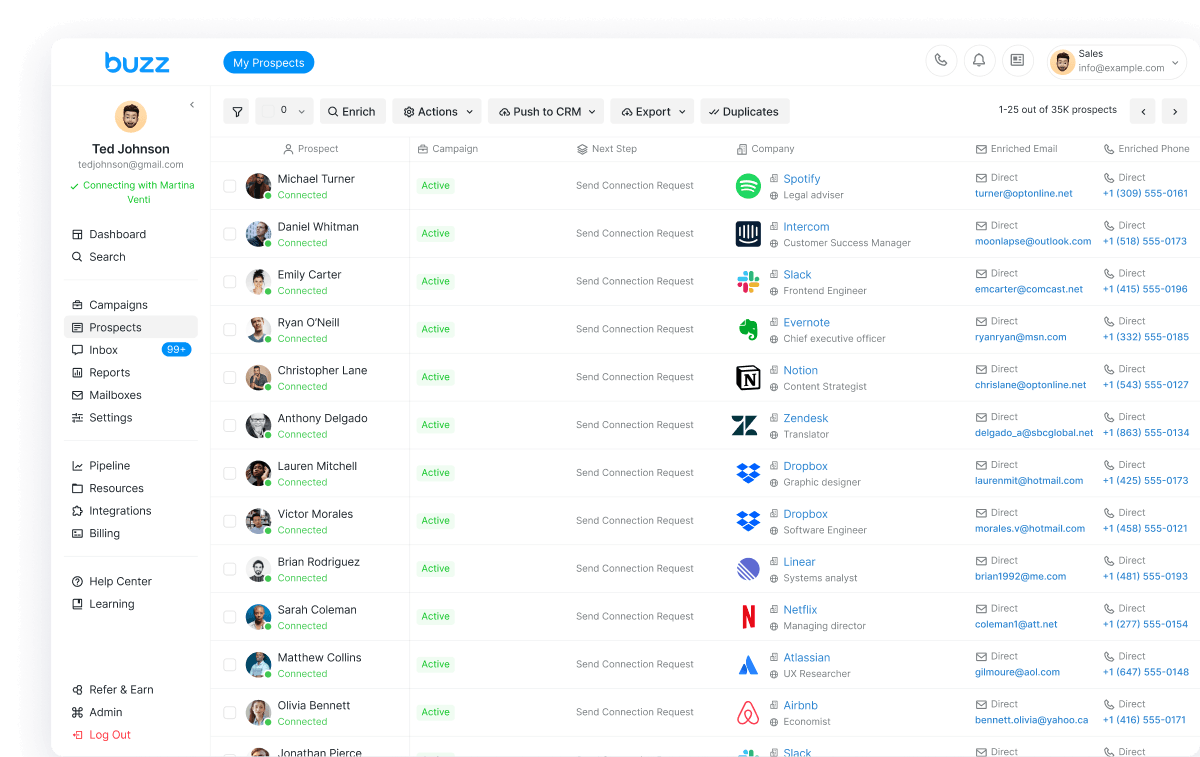
What the $1,000 entry actually runs. Buzz white label is the sequencer you resell first. The published plan is a platform that runs InMail, DMs, Sales Navigator searches, and email sequences — plus a built-in AI assistant. Clients work from a branded dashboard. They never see Buzz.
LinkedIn sourcing and sequences for that motion live on LinkedIn Outreach: Sales Navigator searches and lists, Recruiter projects, posts, events, groups, and CSVs, with InMail, direct messages, and email in the same campaign. That is the LinkedIn-plus-email layer at entry. Do not tell a prospect the $1,000 plan includes calling.
Where call lives. Call is a premium SKU. On AI Employee the product is hire an AI SDR for email, LinkedIn, and call. Phone calling sits there — not in the 20-seat entry. You add AI Employee seats when you have a specialist to sell. The client still logs into your branded workspace. You still own billing. The vendor name still never appears.
Same platform family. Two commercial layers:
- Entry: InMail, DMs, Navigator, email, AI assistant — from https://buzz.ai/whitelabels/.
- Premium: AI Employee seats, including calling — from https://buzz.ai/x/.
You decide which SKU the client buys. They see one product with your name on it.
Email-only outreach stalls when inboxes ignore the tenth cold note. Stacking LinkedIn with email is how you recover; call is the specialist layer on top. Longer argument: Multichannel Sales Automation.
The agency commercial model
Wholesale in. Retail out. The margin is yours.
Buzz white label starts from $1,000/mo with 20 seats included. Billed annually. Native Stripe — charge clients through Stripe, no custom integration. Full admin panel to manage accounts, monitor usage, and control access across your client base. The money page frames launch as one price under your brand: no hidden fees, no per-seat surcharges, no surprises — at the published entry. Confirm public terms at checkout.
Twenty seats are enough to onboard a first cohort as soon as the dashboard is branded. Add seats, data packs, outreach infrastructure, and AI Employee tiers later. Every add-on bills through you, at your margin.
This is how the money page frames the agency case — not invented ROI percentages:
Create recurring software revenue. Turn a one-time service into a monthly subscription your clients pay for as long as they use the platform.
Increase client stickiness. Once clients build workflows on your platform, switching costs make them stay. You become infrastructure.
Sell under your own brand. Your logo, your domain, your name. Clients never see Buzz — they see you.
Avoid building from scratch. Skip months of development and six-figure budgets. The platform is built — just brand it and launch.
Start with a low-friction entry point. Get up and running with 20 seats for $1,000/month. No enterprise hoops to jump through.
Keep selling strategy if you want. The platform is what they pay for when the project hours end.
Operators already on Buzz — Kara Renninger, Kat Atkings, Jon Howard — treat it as infrastructure, not a side tool. White label is that same infrastructure with your name on the login.
Kara Renninger, Founder & CEO: “Before Buzz, I was waiting for clients to find me. Now, I’m scaling a group coaching program that’s passed half a million dollars with one simple, powerful partnership.”
Kat Atkings, COO: “Buzz turned hours of manual outreach into a fully automated system — in just 3 weeks, I booked 10 meetings with a 49% connection rate. It’s like having a full-time sales team working behind the scenes.”
Jon Howard, Founder and CEO: “One tool, one strategy, and suddenly we’re reaching the right people with conversations that convert.”
How Buzz white label works
All commercial terms below are on the live money page: https://buzz.ai/whitelabels/. Confirm there at checkout.
Brand. Upload your logo, set your domain, pick your colors. Your platform is ready. Buzz provisions the branded environment in the background. No engineers needed on your side. Clients never see Buzz.
Wholesale, then retail. Lock in wholesale rates and set your own retail prices. The margin between is yours to keep. Built-in billing: charge clients through Stripe — no custom integrations.
Admin. Control accounts, permissions, and client access. Monitor usage from one panel.
Entry terms (public): from $1,000/mo, 20 seats included, billed annually, annual billing at the entry tier.
Time to live. Setup in 48 hours. Most partners launch their first client the same day they sign up. Go live in days, not months. The platform is ready — brand it and start selling.
| Step | Clock | What you do |
|---|---|---|
| Brand the platform | 0–30 minutes | Logo, domain, colors. Buzz provisions the environment. No engineers on your side. |
| Pricing and invites | 2–4 hours | Connect Stripe, build packages, give clients the branded dashboard. Templates and onboarding flows are ready. |
| Collect revenue | Same day | Clients run outreach. You collect subscriptions. Buzz owns infrastructure, support escalations, and the hard technical questions. You own the brand and the margin. |
AI assistant (included). Helps your clients set up campaigns, write sequences, and respond to prospects. In the $1,000 plan. Not an AI Employee. Not calling.
Do not mix this SKU with the White Label listing on buzz.ai/x/. That path is custom / contact us, with unlimited seats — a different commercial door. Start on /whitelabels/. Add AI Employee when you have a premium tier to sell.
When to add AI Employee
The $1,000 plan is the sequencer you resell: InMail, DMs, Navigator, email, and the AI assistant. It is not a calling product, and it is not a specialist sitting on the account.
Add AI Employee when you are ready to sell a specialist, not just a sequencer. Each AI Employee is purpose-built for a specific role. Clients pick the ones they need. You earn on every seat.
On /x/, the line is hire an AI SDR for email, LinkedIn, and call. Phone calling lives on that SKU. Onboard is about 15 minutes. That is the premium layer — the third channel in the outbound stack — not the entry dashboard.
If the search is white-label AI SDR rather than outbound software, use White Label AI SDR. Same partner motion. Different package name. Do not sell calling, voicemail, or AI Email Service as part of the $1,000 talking points. Those are add-on and AI Employee territory. Confirm anything not listed on /whitelabels/ at checkout or with sales.
Resell outbound. Keep your name on the login.
If the search was white label outbound software, you do not need another done-for-you retainer. You need a branded platform your clients still log into next quarter — email and LinkedIn at entry, call when you sell the specialist.
- Primary: Build your white label setup — https://buzz.ai/whitelabels/ — from $1,000/mo, 20 seats, billed annually, live in 48 hours. Confirm at checkout.
- Add AI Employee seats when you sell a specialist.
Check /whitelabels/ for the public entry terms. Contact sales for anything that is not on that page.