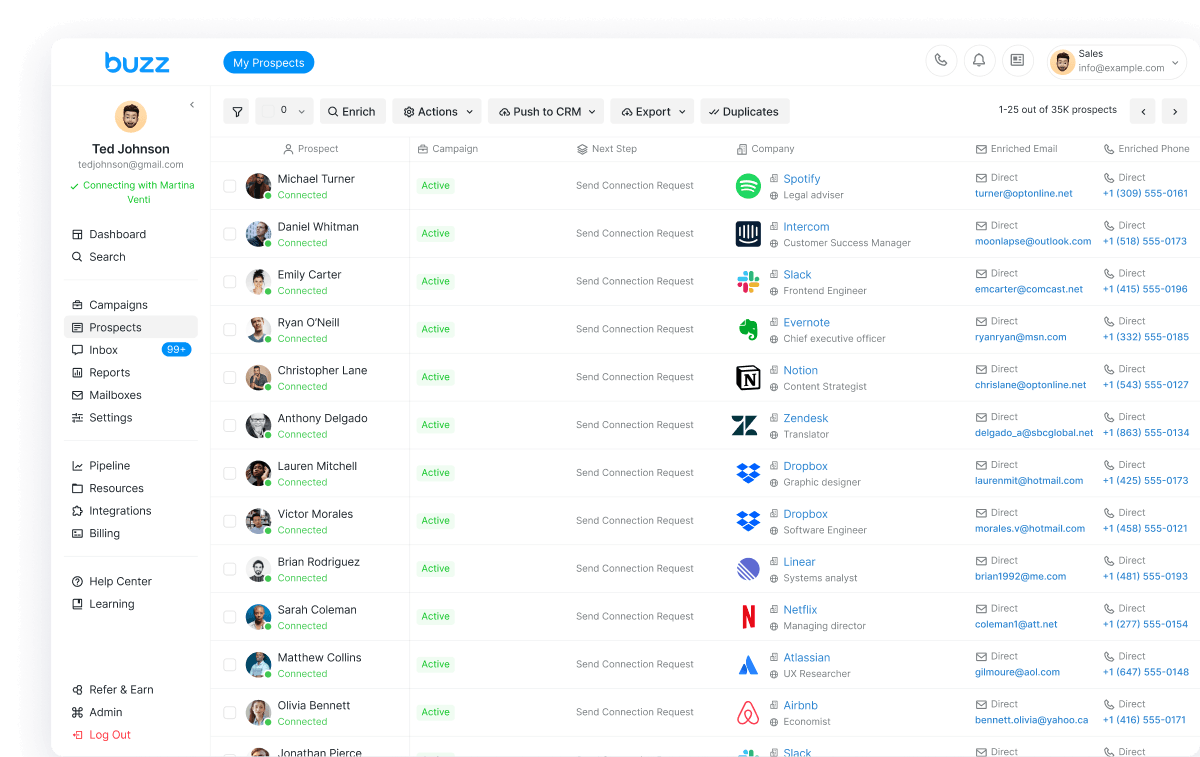
Agencies still sell SDR capacity as hours. Buyers searching white label AI SDR want an AI sales agent under their brand — a seat they invoice every month, on a login that never shows the vendor.
White label AI SDR: resell an AI sales agent under your brand. Buzz does this as AI Employee seats—a premium SKU on the white-label platform (email, LinkedIn, call; ~15-minute onboard). You earn on every seat. Start from $1,000/mo, 20 seats; add AI Employee when you sell the specialist.
What a white label AI SDR actually is
A white label AI SDR is an AI sales agent you license, brand, and resell. The client logs into your product. The agent works their pipeline. They never see Buzz.
It is not a human SDR in a staff-aug wrapper. You are not placing a contractor on Slack and calling the markup “white label.” There is no ramp class, no quota spreadsheet, no person to replace when they quit. The buyer is paying for an agent under your name, not a body in your delivery bench.
It is also not the entry white-label sequencer by itself. The public Buzz white-label plan starts from $1,000/mo with 20 seats, a branded dashboard, Stripe, and a built-in AI assistant that helps clients set up campaigns, write sequences, and respond to prospects. That assistant is included. An AI Employee seat is not. Do not sell the $1,000 plan as an AI SDR.
The cluster already named this SKU. White label LinkedIn automation is the branded platform — logo, domain, InMail, DMs, Navigator, email. Call it white label AI SDR when you add AI Employee seats as the premium tier. Same platform. You name the packages.
Three things still have to be true or it is not white label:
- Clients never see the vendor. Logo, colors, domain — every screen they touch is yours.
- You own pricing. Wholesale in, retail out, margin in the middle.
- You own the relationship. Admin, seats, permissions, and billing run through you.
If you only need meetings for your own book, skip the reseller layer and hire an AI Employee direct. If you invoice other companies for an AI sales agent, this is the SKU.
AI Employee is the premium SKU
buzz.ai/whitelabels/ is blunt: add premium tiers with AI Employee. Each AI Employee is a specialist — purpose-built for a specific role. Your clients pick the ones they need. You earn on every seat.
That is the commercial spine. The $1,000 / 20-seat entry gets you a platform you can put your name on. The AI SDR offer is the specialist seat you attach when a client wants an agent, not just a workspace.
How the money moves, as published on /whitelabels/:
- Brand. Upload your logo, set your domain, pick your colors. Clients never see Buzz.
- Wholesale, then retail. Lock wholesale rates, set your own retail, keep the margin.
- Stripe. Built-in billing. Charge clients through Stripe — no custom integration.
- Admin. Accounts, permissions, client access. Monitor usage from one panel.
- Seats. Start with 20 included — enough to onboard a first cohort.
Add-ons, including AI Employee seats, run through your Stripe at your margin. You own retail. Buzz owns infrastructure, support escalations, and the hard technical questions.
The only public $ on this motion is from $1,000/mo, 20 seats, on /whitelabels/. Confirm there at checkout. Contact sales for anything that is not on that page.
buzz.ai/x/ also lists a White Label plan as custom pricing with unlimited seats. That is not the $1,000 checkout. Do not mash those two offers into one SKU. Start branded on /whitelabels/. Add AI Employee when you have a specialist to sell.
Operators already on Buzz — Kara Renninger, Kat Atkings, Jon Howard — treat the stack as infrastructure, not a side tool. White label is that infrastructure with your name on the login. AI Employee seats are the premium line you invoice on top.
What the agent does
All agent behavior below is as published on https://buzz.ai/x/. This is what you resell as the AI SDR SKU. It is not what the $1,000 plan includes by default.
Channels: email, LinkedIn, and call. Phone Calling is listed on /x/.
Onboard: around 15 minutes. A typical sales representative takes 3–6 months. The AI Employee aggregates company data from the web and trains on offers, pricing, ideal customer profile, value propositions, and outbound objectives — it onboards itself.
Motion: identify, engage, manage, and book meetings. Using the business, the objective, and the ICP, it helps build a sales playbook: tailored pitches, response templates, and follow-up paths from cold prospect to meeting booked. It analyzes prospect concerns, handles objections, re-engages threads that go quiet, and books meetings in Calendly.
Campaigns: it creates five multichannel campaigns from the defined sales objective — every outbound step, message, and follow-up on LinkedIn and email. Every prospect gets a personalized message.
Listed extras on /x/ — quote these as AI Employee capabilities, not $1,000-plan facts:
- AI Email Service — 600 emails/day, 4 monitored domains, 12 warmed mailboxes, built to improve deliverability and reply rate
- Connection Booster
- InMail Booster
- Social Search URL, Social Post URL Search, Social Event URL Search, Social Group URL Search
- Phone Calling
The LinkedIn sourcing those searches sit on is the same motion as LinkedIn Outreach: Sales Navigator searches and lists, Recruiter projects, posts, events, groups, and CSVs. Sequences can include InMail, direct messages, and email, with enrichment so LinkedIn leads can move to email, plus unlimited campaigns and touchpoints in one workspace.
Integrations named on /x/: Calendly (track meetings, trigger campaign actions, book more meetings), HubSpot, and Pipedrive.
If you want the operator playbook for the 15-minute onboard — not the reseller wrap — read Hire an AI Employee for Sales. This post is the agency SKU: you sell the seat; Buzz runs the agent.
How agencies package it
Two layers. Do not collapse them.
Layer 1 — branded platform (entry). From $1,000/mo, 20 seats, billed annually, setup in 48 hours, native Stripe. Logo, colors, domain. Admin for accounts, permissions, and client access. Built-in AI assistant for campaign setup, sequence writing, and replies. This is the login your clients bookmark. No sales call is required to see your setup. Confirm live terms on https://buzz.ai/whitelabels/.
Layer 2 — AI SDR seats (upsell). AI Employee specialists. Clients pick what they need. You earn on every seat. You set retail. Buzz runs infra.
Most partners launch a first client the same day they sign up. The clock on /whitelabels/:
- 0–30 minutes — brand. Upload logo, set domain, pick colors. Buzz provisions the environment in the background. No engineers on your side.
- 2–4 hours — pricing and invites. Connect Stripe, build packages, give clients the branded dashboard. Templates and onboarding flows are ready.
- Collect subscription revenue. Clients run outreach. You collect subscriptions.
Name the packages in your language. A clean split: a platform seat (branded workspace + AI assistant) and an AI SDR seat (AI Employee). You set both prices. Write wholesale vs retail down so the margin is intentional — /whitelabels/ exists so you can lock wholesale and keep the spread.
Week-one math is boring on purpose. Twenty seats. One AI SDR offer you can actually sell. Two or three design-partner clients, not ten strangers. Success metric: meetings booked from the branded workspace, not vanity sends. When they ask for the agent, you already have the upsell: AI Employee seats through your Stripe.
If you also sell a broader outbound stack under the same brand, the parallel post is white label outbound software. LinkedIn-first packaging lives on white label LinkedIn automation. This page is the AI SDR SKU only.
You do not need a delivery team to “be the SDR.” The client gets an agent. You get recurring software revenue and stickiness: once campaigns and pipeline live in your dashboard, switching costs make them stay. You become infrastructure.
Who sells this vs who buys AI Employee direct
Resell if you invoice other companies. Buy direct if you only need your own pipeline. There is no third public plan.
| You are… | Buy |
|---|---|
| Agency / reseller packaging an AI SDR as your product | White label on buzz.ai/whitelabels/, then AI Employee seats |
| SaaS attaching an AI sales agent to an existing product | White label, then AI Employee seats |
| Consultant selling branded seats | White label, then AI Employee seats |
| In-house team that just needs pipeline | AI Employee direct |
Agencies. You already sell retainers for outbound, LinkedIn, or done-for-you SDR. White label turns that retainer into software revenue. The AI SDR SKU is how you stop delivering the hours yourself.
SaaS. Customers keep asking for outbound. Building an AI sales agent is a year of engineering you will not get back. White label is the attach: your brand, your domain, your Stripe — then AI Employee seats on top of the product you already sell.
Consultants and operators. You want to resell an AI sales agent without a delivery bench. Twenty seats onboard a first cohort. You set packages, invite clients, collect subscriptions. Add the specialist when someone buys the agent.
Buy AI Employee direct if you need outbound for your pipeline, not a product to resell. https://buzz.ai/x/ is the shorter path. White label adds branding, Stripe, and client admin that a single sales team does not need.
The custom White Label row on /x/ (unlimited seats, contact-us pricing) is an enterprise conversation, not the published $1,000 / 20-seat entry. Agencies start on /whitelabels/. Direct operators start on /x/. Same AI Employee. Different commercial wrapper.
Resell the AI SDR. Keep your name on the login.
If the search was white label AI SDR, you do not need a human SDR in a branded hoodie. You need a platform with your name on the login, and a specialist seat you can invoice.
- Primary: Build your white label setup — from $1,000/mo, 20 seats, Stripe, live in 48 hours. Add AI Employee seats when you sell the AI SDR SKU.
- Confirm public terms on /whitelabels/. Contact sales for anything that is not on that page.