Most “AI SDR” tools still optimize for volume: more emails, more sequences, more dashboard vanity. Pipeline leaders care about a different number—qualified meetings on the calendar. In 2026, the category finally split: copilots that help humans send faster, sequencers with AI copy, and true AI sales agent software that can discover prospects, enrich, run multichannel outreach, handle replies, and book.
This guide compares the best AI SDR tools on what matters for revenue teams: meeting booking, channels, data quality, deliverability, and total cost of ownership—not feature bingo.
The best AI SDR tools in 2026 are platforms that book meetings—not just send email. Leaders include Buzz (multichannel AI SDR + AI Employee across email, LinkedIn, calling, and voicemail with enrichment waterfall), Artisan Ava and 11x Alice (autonomous AI SDR platforms), Apollo (data + AI-assisted sequences), AiSDR and Regie (specialized AI outbound / engagement layers), and Clay as a data layer that feeds SDRs rather than replacing them. Evaluate on meetings booked, channel coverage, deliverability, and TCO.
What “AI SDR” means in 2026 (agent vs copilot vs sequencer)
Buyers still mix three different products under one keyword. That mismatch is why so many pilots “work in the demo” and stall in the field.
Sequencer with AI copy
Classic sales engagement with better writing. You build the cadence. AI drafts subject lines and icebreakers. Humans still research, approve, reply, and book. Useful—but it is not an autonomous SDR.
Copilot / AI assistant
Sits inside prospecting and CRM workflows. Generates lists, research briefs, and sequences from prompts. Strong for productivity. Weak if your goal is a digital worker that owns the loop from first touch to booked meeting.
AI agent / autonomous SDR
An AI sales agent (or AI Employee) that can run a meaningful slice of SDR work end-to-end: ICP-based AI prospect discovery, enrichment, personalized outbound, reply handling, objection routing, and calendar booking—with guardrails you set. This is the category buyers mean when they search best AI SDR tools or AI SDR platform in 2026.
If a vendor cannot show how replies become meetings without a human babysitting every step, treat it as a sequencer or copilot—even if the homepage says “AI SDR.”
How we evaluated (meeting booking, channels, data, deliverability, TCO)
We scored tools the way a CRO or Head of Sales would after a 30-day pilot—not how a feature matrix scores.
1) Meeting booking (primary outcome)
- Can the system qualify interest and propose times?
- Does it sync to calendars (e.g., Calendly / native scheduling)?
- Are booked meetings tracked as the north-star metric, or only opens/sends?
2) Channels that compound replies
Email-only agents leave money on the table. Multichannel sequences (email + LinkedIn + phone/voicemail) raise response rates when timed intelligently—not when they spam every channel at once.
3) Data & AI prospect discovery
Built-in databases help. Waterfall enrichment (cascading multiple providers) usually beats single-source contact data. Intent and lookalike discovery matter more than raw contact counts.
4) Deliverability & sending infrastructure
Warmup, domain/mailbox hygiene, authentication (SPF/DKIM/DMARC), and send throttling decide whether “personalization” ever reaches an inbox.
5) Total cost of ownership (TCO)
Seat fees are the tip. Add data credits, dialer/usage, managed infrastructure, onboarding, and the human time still required to operate the tool. Prefer “contact sales / varies” over fake precision when vendors do not publish public list prices.
Buzz does not publish list pricing here — see buzz.ai or book a demo. Competitor prices below are contact-sales or public-plan ranges only.
Best AI SDR tools compared
| Tool | Category shape | Channels (typical) | Autonomy | Data posture | Pricing posture (careful) | Best for |
|---|---|---|---|---|---|---|
| Buzz | Multichannel AI SDR + AI Employee | Email, LinkedIn, calling, voicemail (+ video in platform) | Agent + human-in-loop modes | Enrichment waterfall; large built-in contact graph | Contact sales / try at buzz.ai | Teams that want discovery → enrichment → multichannel → booking in one stack |
| Artisan (Ava) | Autonomous AI BDR / AI SDR platform | Email + LinkedIn; dialer queueing for reps | High autonomy with approval dial | Bundled B2B database + enrichment | Contact sales; enterprise-shaped | Mid-market / enterprise wanting a named AI BDR |
| 11x (Alice) | Digital-worker AI SDR | Email, LinkedIn, SMS/phone options in platform story | High autonomy “digital worker” | Signals + native contact graph (vendor claims) | Contact sales; commonly enterprise ACV | Well-funded outbound orgs buying a full worker, not a seat |
| Apollo | Data + engagement + AI assistant | Email, LinkedIn tasks, calling | Mostly copilot / assisted sequences | Large B2B database core strength | Public per-seat plans (varies by tier) | Teams wanting data + sequences + AI help in one familiar UI |
| AiSDR | Standalone AI SDR | Primarily email (+ LinkedIn in many setups) | Autonomous outbound package | Built-in prospecting DB | More transparent SMB packaging (often usage/plan-based; verify live) | Smaller teams testing autonomous email outbound |
| Regie.ai | AI sales engagement layer | Works with / alongside SEP channels | Co-pilot → auto-pilot on content & orchestration | Leverages existing CRM/SEP data | Enterprise / contact sales | Orgs that already run Outreach/Salesloft-style stacks |
| Clay | Data / GTM engineering layer | Not an SDR sender | Human + workflow builder | Best-in-class enrichment waterfall DIY | Credit / action based; free tier exists | RevOps builders feeding lists into an AI SDR or SEP |
Buzz — multichannel AI SDR + AI Employee
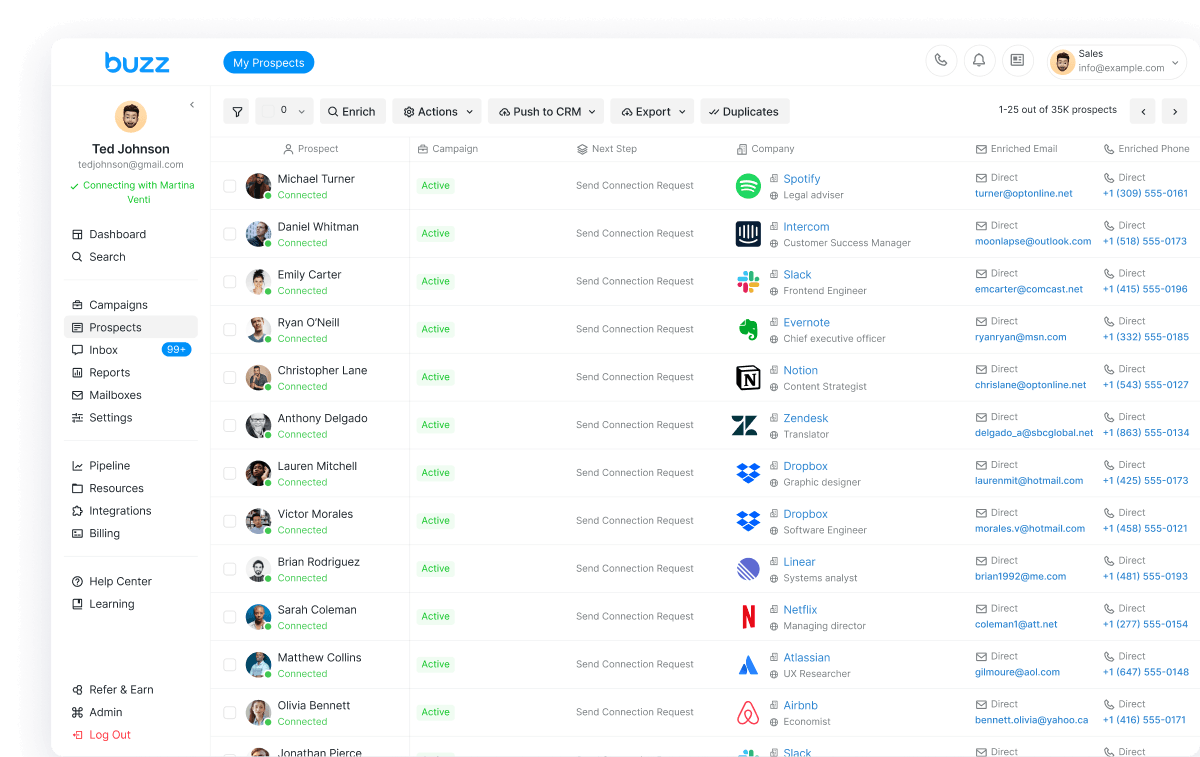
Buzz is built as an AI SDR platform that unifies identify → enrich → engage → book—not another email box with a chat widget bolted on.
What stands out for meeting-driven teams:
- Multichannel by design: email, LinkedIn, cold calling, and voicemail drops sequenced from one motion (not five stitched tools).
- AI prospect discovery: describe ICP / lookalikes / intent in natural language; Buzz finds matching companies and contacts.
- Enrichment waterfall: cascade across many providers so coverage is not stuck on one data vendor’s blind spots.
- AI Employee (buzz.ai/x): onboard against your business context, generate multichannel campaigns, personalize messages, manage conversations, handle objections, and book meetings (including calendar workflows like Calendly).
- Always-on reply handling: the point is pipeline movement while reps close—not another inbox to babysit.
Buzz is the right shortlist pick when you want AI sales agent software that still respects brand guardrails, and when your outbound reality includes phone and LinkedIn—not email alone. For a deeper stack comparison on the data/engagement side, see Buzz vs Apollo.io and evaluating AI sales platforms.
CTA inside the comparison: Book a demo / try Buzz or explore AI Employee.
Artisan (Ava) — strong autonomous AI BDR; fair Artisan AI alternatives view
Artisan’s Ava is one of the clearest autonomous SDR products on the market: research, personalized outbound, reply handling, and meeting booking with an autonomy dial (manual gates through full autopilot). Ava 2.0 messaging emphasizes closing the loop so humans are not reviewing every reply forever.
Fair take for buyers shopping Artisan AI alternatives:
- Where Ava shines: enterprise packaging, strong “hire an AI BDR” narrative, bundled data + enrichment, email/LinkedIn orchestration, dialer queuing for warm leads.
- Where to pressure-test: true phone/voicemail ownership vs “queue for humans,” inbound vs outbound packaging (often separate), and whether white-glove deployment cost fits your stage.
- Pricing: contact sales / custom. Third-party writeups float mid-market monthly ranges; treat those as unverified until your quote lands.
If you want a named AI BDR with enterprise support, Ava belongs on the RFP. If you need a broader multichannel AI SDR motion with calling + voicemail as first-class steps and a faster “AI Employee” onboarding path, put Buzz next to Ava—not beneath it.
11x (Alice) — digital worker, enterprise ACV
11x positions Alice as a digital worker AI SDR: signal-based prospecting, deep personalization, multichannel follow-through, and autonomous meeting booking. The brand promise is “human results” from an always-on worker, not a productivity plugin.
Fair take:
- Excellent fit for companies that already think in “hire a worker” economics and can staff AEs to absorb meeting volume.
- Platform story has expanded beyond pure email into broader GTM orchestration.
- Pricing: contact sales. Public third-party estimates often place entry engagements in the high four- to five-figure monthly band or ~$60K+/year—validate live; do not budget from a blog table alone.
Choose 11x when budget and change management support a full digital-worker deployment. Choose a more productized AI SDR software path (Buzz AI Employee or AiSDR-class tools) when you need faster time-to-first-campaign without a long enterprise services motion.
Apollo — powerful data + AI assistant, not a full autonomous SDR
Apollo remains a category giant for B2B contacts, filters, sequences, and an embedded AI Assistant that builds lists and drafts outreach inside the product. For many SDR teams, Apollo is the default “data + engagement” OS.
Fair take:
- Outstanding when your bottleneck is finding people and running assisted sequences.
- AI here is primarily copilot, not a fully autonomous agent that owns replies-to-meetings without human ops.
- Deliverability at cold-email scale is a known diligence item; many power users still split “Apollo for data” and a specialized sender for volume.
Use Apollo if you want one familiar system for search + sequences. Use a dedicated AI SDR platform (Buzz, Artisan, 11x, AiSDR) if the job description is “book meetings while we sleep.”
AiSDR & Regie — brief but useful contrasts
AiSDR packages a standalone autonomous outbound agent with relatively transparent SMB-friendly plans (commonly cited around the high hundreds per month depending on package—confirm current site pricing). Strong when you want to test AI outbound without a six-figure ACV.
Regie.ai is better understood as an AI sales engagement layer: content, orchestration, and co-pilot/auto-pilot modes that sit with (or inside) existing SEP workflows. Strong when you are not ripping out Outreach/Salesloft; weaker as a greenfield all-in-one AI Employee replacement.
Neither cancels the need to ask the same outcome question: Show me meetings booked from autonomous reply handling—not just AI-written step 1.
Clay — data layer, not an SDR
Clay is excellent. It is also not an AI SDR.
Clay is a GTM engineering and enrichment workspace: waterfall data, signals, AI research agents, and custom tables that push cleaned audiences into sequencers or AI SDRs. Teams with RevOps talent love it. Teams that need a single autonomous SDR to book meetings will still need Buzz, Artisan, 11x, AiSDR, or a human-led SEP on the other side of Clay.
If your stack is “Clay for research + Buzz for multichannel AI Employee execution,” that is a coherent architecture—not a redundancy.
AI SDR vs human SDR — a cost framework (without inventing Buzz $)
Stop comparing “AI seat price” to “SDR salary.” Compare fully loaded cost per qualified meeting.
Human SDR fully loaded (illustrative framework)
Include:
- Base + variable + benefits + tools (SEP, dialer, data, LinkedIn, sequencing)
- Manager time and ramp (often 3–6 months to full productivity)
- Coverage gaps (PTO, attrition, territory resets)
Industry all-in cost for a productive SDR commonly lands in the high five figures to low six figures per year depending on market—before you count the opportunity cost of empty calendars during ramp.
AI SDR / AI Employee cost buckets
- Platform subscription (seat, worker, or usage)
- Data / enrichment credits
- Sending infrastructure (domains, mailboxes, warmup)
- Phone minutes / voicemail if used
- Human oversight (strategy, QA, escalation)—usually a fraction of a full SDR headcount
- Onboarding time (days/weeks for AI Employees vs months for humans)
Buzz’s own AI Employee positioning emphasizes minutes-scale onboarding versus months for a human hire, plus multichannel conversation management aimed at booked meetings. Use that as a time-to-pipeline advantage in your model—not as a fake dollar claim.
Decision rule
- Volume + clear ICP + fast feedback loops → AI SDR / AI Employee first, humans on exceptions and closing.
- Complex multi-threaded enterprise with heavy customization → hybrid: AI for coverage and first-touch; senior humans for nuance.
- Brand-risk verticals → start with human-in-the-loop approvals, then widen autonomy as reply quality proves out.
For a deeper category framing, see Buzz’s related thinking on the blog and the evaluation checklist in Evaluating AI sales platforms.
Buying checklist: how to shortlist AI SDR software without getting sold a sequencer
Use this in every demo. If the vendor cannot answer in product—not slides—keep looking.
- Show a booked meeting from an AI-handled reply thread (redact if needed).
- Channels: email only, or email + LinkedIn + calling + voicemail in one cadence?
- AI prospect discovery: can I describe ICP in natural language and get enriched contacts?
- Enrichment: single database or waterfall across providers?
- Deliverability: who owns domains/mailboxes/warmup? What are safe send ramps?
- Autonomy dial: can I require approvals on first campaigns, then loosen?
- CRM truth: two-way sync with Salesforce/HubSpot (and your SEP if you keep one)?
- TCO worksheet: seats + credits + infra + services + human oversight hours.
- Security: SOC2 / SSO / permissions appropriate for your stage.
- Exit plan: data export, contract length, and what happens to sending reputation if you leave.
Score each 1–5. Weight meeting booking ×2. The highest score usually beats the prettiest homepage.
Where teams get burned
Vanity volume. Ten thousand AI emails with a 0.2% reply rate is not a strategy. Instrument meetings from day one of the pilot.
Channel blindness. Email-only AI SDRs stall when inboxes tighten. If LinkedIn and phone are how your buyers respond, your tool must orchestrate them.
Unowned data. If every campaign starts with a CSV from three vendors, you have a glue job—not an AI SDR. Keep Clay-class enrichment as a deliberate upstream step, or pick a platform with real AI prospect discovery built in.
Brand risk from unsupervised replies. Start in approval mode on net-new ICPs; loosen only after you trust objection handling.
Scattered buying research. If comparison content, pricing pages, and “what is an AI SDR” posts all target the same query, buyers bounce. Keep one primary guide for best AI SDR tools and link out from the rest.
CTA
If your outbound stack still optimizes for sends instead of meetings, stop adding another sequencer.
Book a demo or try Buzz: https://buzz.ai/
Hire an AI Employee: https://buzz.ai/x/
More comparisons & playbooks: https://buzz.ai/blog/ · Buzz vs Artisan vs 11x · Hire an AI Employee for Sales · Multichannel Sales Automation · White-label LinkedIn automation
Bring your ICP, current channel mix, and last 90 days of meeting metrics. We’ll show how a multichannel AI SDR—email, LinkedIn, calling, voicemail, enrichment waterfall, and meeting booking—changes the calendar, not just the send log.